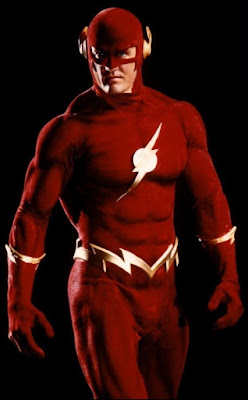
| Famed comics artist and Rocketeer creator, Dave Stevens, drew the concept art for the Flash costume. |
Tuesday, October 26, 2021
The Flash (1990) - Review and Analysis
Wednesday, October 20, 2021
Lois and Clark (1993-1997) - Review and Analysis
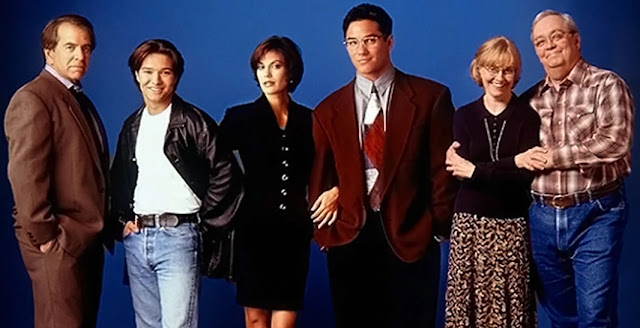
Debuting in 1993, Lois and Clark: The New Adventures of Superman was a television show that attempted to further the Superman legend by injecting romance into its super heroics. It ran for four seasons on ABC and followed the immediate Post-Crisis comic book continuity established by John Byrne et al. This was the first incarnation where Clark was the real identity and Superman was just a heroic persona.
Lois and Clark is a very entertaining show. The first season is the best, largely because of the dynamics between John Shea's Lex Luthor and Dean Cain's Superman. The plots of the show vary greatly. Action heavy stories give way to suspense. There's occasional cheesy comedy to balance out the romantic drama between the title characters, but it's the romance that really drives the show. The best episodes, for me, are when Superman's humanity is explored. The chemistry between Teri Hatcher and Dean Cain really draws you in and keeps you invested. The magic of the show really comes down to the cast.
Dean Cain is the best live-action Clark Kent ever. His Clark is the most fleshed out of any live-action version. Every time he is on screen he just exudes charm... Cain's Superman however, while very serviceable for a romantic adventure show, left a lot to be desired because there was very little to distinguish Cain's Superman from his Clark. For my money, the best Superman still is Christopher Reeve.Teri Hatcher delivers the definitive portrayal of Lois Lane. She defines every one of Lois' traits perfectly... the tough, brash, no-nonsense reporter. She's also very charming and sexy. If any of the other Lois' compare to her, the one that springs to my mind is Dana Delaney from Superman: The Animated Series in the 90's. Teri just nails Lois Lane perfectly.
Lane Smith as Perry White is just a complete character. Lane's Perry is very likable, funny, charming, and a genuinely good person who cares about his reporters. He's got the Elvis obsession that comes from the modern Perry from the comics. While I like John Hamilton (from the 1950's Superman show) and Jackie Cooper (the Reeve movies) in their roles, they don't get the rounded character of Perry as much as Lane Smith does. To be fair though, Lane Smith had four seasons to develop Perry into a real character.
Then there's Jimmy Olsen... Michael Landes did a good job with what he was offered but didnt get enough time to shine. He was good in the role but had he been given more time to develop, he probably would have been great. When I think of Jimmy Olsen, it's Justin Whalin that I think of. Whalin gave us the Daily Planet photographer as I'd always wanted to see him... curious, mischievous, a modern teenager.
Eddie Jones and Kay Kalin were great as The Kents. They seemed like the kind of parents (or grandparents) that you'd wanna have... just two very genuine and caring people... not too bland and old fashioned either, which was nice; a modern update on Ma and Pa Kent.
And now we come to my favorite part of the show: John Shea. His Lex Luthor was absolutely the most vile character and the perfect Lex Luthor. Arrogant, charismatic, narcissistic, and evil. His hatred for Superman is fiery. There were moments in that first season where he scared me. John Shea is the best Lex Luthor in live-action. He gave an absolutely stunning performance. No other Luthor compares in my mind, though Clancy Brown's Lex is the best animated version.
Tracy Scoggins as Cat Grant was interesting. Rather than giving fans the character from the books, they rewrote her as the office gossip. Tracy was great in the role, even if it was a different character. They axed her after the first season and she deserved better. They could have given her a credible exit, at the very least.
I also liked the character of Jack from Season 1 and would have preferred if he'd stuck around for the rest of the series. He was a cool addition to the cast.
Beyond the cast is the writing and production design. Lois and Clark features pretty conventional writing for a 1990's superhero TV series that turned into a romantic comedy/drama. The plots are fun and try to juggle human drama, light comedy, and comic book/sci-fi themes. Even if the budget doesn't always allow for the greatest effects work, the show holds up. I also think the production design was stellar. Dean Cain's Superman costume looked great on screen and every setting, from the Kent farm to the Daily Planet, even Luthor's penthouse, was spectacular.
Sunday, August 15, 2021
Popeye The Sailor Man!
Best known as a cartoon character from the 1930's and 40's and rebooted several times from the 1960's to today, Popeye was created in a newspaper comic strip by King Features Syndicate called Thimble Theatre, written and drawn by Elzie Segar. The character would eventually grow so popular that he took over the strip and it was renamed in his honor.
The sailor's popularity expanded yet again into comic books, video games, advertisements for everything from spinach to candy cigarettes, and in 1980 was adapted for the screen in a live action film, starring Robin Williams.
The 1980 movie feels quite literally like an old Popeye cartoon in live action, though it has elements of the comic strip version of Popeye too. The performances are probably as faithful to the Popeye cartoons as is possible. Robin Williams translates the character to live action almost perfectly. The production design, sets, costumes and overall plot adapt the sailor and his world very effectively. It's a very entertaining film for its time and I enjoy it, but I have heard that some modern audiences criticize it for pacing.
One of the most frequent tropes of the Popeye cartoons is the love triangle between Popeye, Olive, and Bluto. Bluto serves as the rival to Popeye, who usually bests the large brute in a duel of wits and strength. While this provides a lot of humor to the stories, it separates the cartoons from the comic with a key difference: Bluto only appeared one time in the strip and the comic featured more complex plots than the simple love and rivalry of the cartoons. Also, in the comic strip, Popeye rarely ate spinach. The differences in the strip and cartoon have sometimes led to the perception that the strip was for all ages and the cartoon was more children's fare though it should be noted that in the 1930's and 40's people of all ages were entertained by cartoons.
The legacy of Popeye has been one of pure entertainment for young and old alike. The stories feature a character who is an odd mix of rough and tumble mariner, caring gentleman, and archetypal hero. Charles Schultz, of Peanuts fame, called Popeye "the perfect comic strip." In all media, in all his incarnations, the sailor's adventures offer a brilliant mix of adventure and humor with Popeye as the strongman archetype. In fact, Popeye was mentioned by Jerry Siegel as one of the early inspirations for Superman. Popeye has become so beloved that he continues to endure today, still published as a strip in several American newspapers, and new cartoons and animated movies still debut every few years.
Wednesday, July 14, 2021
Batman Animated: Mask of the Phantasm, SubZero, World's Finest - Review and Analysis
Batman was in a great place in the 1990's as far as animation goes. Mask of the Phantasm began as an idea from Alan Burnett, producer on Batman: The Animated Series. Burnett wanted to tell a Year One inspired story that explored how Bruce Wayne became Batman but also wanted a movie that told a new story. Paul Dini, Martin Pasko, and Michael Reaves were recruited to help write the film. Much of the main voice cast of the animated show returned to do voices: Kevin Conroy as Batman, Mark Hamill as The Joker, Efrem Zimbalist Jr. as Alfred Pennyworth, Bob Hastings as Commissioner Gordon, and Robert Costanzo as Harvey Bullock were joined by veteran actors Dana Delany, Hart Bochner, Stacy Keach Jr., Abe Vigoda, Dick Miller and John P. Ryan to fill out the cast. The movie was directed by Bruce Timm and Eric Radomski.
The story follows Batman as he reunites with his former love, the mysterious socialite, Andrea Beaumont, then faces a new vigilante, The Phantasm, who is murdering Gotham's mob bosses. The plot took partial inspiration from Mike W. Barr's Batman: Year Two and The Phantasm was based on the comics villain, The Reaper. The movie also took elements from the Batman: Year One storyline by Frank Miller.
After Phantasm was greenlit, WB had slated it for a direct-to-video release. When the film was completed though, the executives were impressed enough with the animation and overall story that they decided it was worthy of a theatrical release. They then decided to convert its aspect ratio for theater screens. Dropping on December 25, 1993, it opened to a very small reception but got positive reviews from the few critics who did see it. The film earned praise for its stylized animation, voice performances, story, and music. Because of the film being dumped into theaters on such short notice, Mask of the Phantasm was a box office bomb. In fact, because it was such a sleeper, Siskel and Ebert dismissed it as, to quote Gene Siskel, "a kid's movie." They failed to review it but later came back and gave the film a glowing review (as seen below):
After being released on VHS, this film finally found the success it deserved and has gained a legendary status among fans. And this is where I first saw it. I used to rent this once a month from the video store. In my estimation, it's one of the best Batman movies ever made. Sometimes, I even think that it beats the best live action films with its story and execution. Mask of the Phantasm is well remembered and continues to be loved by Batman fans, new and old.
In 1997, around the time of the 4th Batman film, Batman and Robin, WB filmed a tie-in movie called Batman & Mr. Freeze: SubZero. After the lack of critical success that the live action film brought, SubZero was halted and released in 1998 as a Special Television Event. My brother and I had seen it advertised for weeks and saw it when it debuted, recording it on a VHS tape. The film was critically well received and, for obvious reasons, is regarded as far better than the live action film from around the same time. As a young kid, this was the movie that cemented my love for Barbara Gordon and Batgirl.
The film used much of the same cast from the animated series to tell a story where Mr. Freeze recruits an old colleague, Dr. Gregory Belson, to perform a blood transfusion to heal and revive his beloved wife, Nora. The plot comes in when the only compatible donor happens to be Barbara Gordon. Freeze kidnaps Barbara and takes her to an abandoned oil rig in the middle of the ocean. Barbara uses her wits to survive and Batman and Robin fly out in the Batwing to rescue her.
The film was critically well received, though I personally have seen it criticized online by a few fans who think the movie is too short and the story too simple. It certainly always entertained me and I think it works as a perfect extension of the show it's based on. Its runtime is just over an hour but I think it tells a better story and is more faithful to what Batman (and Mr. Freeze) represents than what Schumacher gave us in 1997.
Also in 1997, 3 episodes from the second season of Superman: The Animated Series debuted back-to-back as a special TV-movie event. These episodes depicted the first meeting between Batman and Superman in the DC Animated Universe (DCAU). As far as episodes go, they were some of the best of the Superman show and told an engaging story.
Joker meets Lex Luthor in Metropolis with an offer to kill Superman using a kryptonite dragon statue. Batman and Superman must team up to bring down the scheme of their arch villains. Sure, the plot is simple Saturday morning fare but the writing elevates it to something special.
In 2002, WB dumped these episodes onto DVD as The Batman/Superman Movie: World's Finest! Is it bad that I enjoy this more as a pairing of my 2 favorite DC heroes than the live action DC Extended Universe films? I'm apparently not the only one... several other fans have told me that they feel this is more entertaining than Zack Snyder's work and is a truer representation of Batman and Superman. I still think these 3 episodes are great and have loved them since I was a kid.
*If you haven't watched these in a while, I recommend you see them again because I just saw them for the first time in a few years and they are really fun and quite engrossing. Bruce Timm and co. really knew how to make good superhero entertainment.
Wednesday, June 2, 2021
The Batman Runs by Grant/Breyfogle!
Starting in 1987, with Detective Comics issue #583, DC Comics unleashed one of the greatest creative team's to ever work on Batman! Alan Grant (with an assist by John Wagner on the first few tales) wrote some of the most memorable stories of the Post-Crisis era, precisely because they chose not to use many of Batman's main villains. They created new ones. And while it's debatable whether or not some of these villains are well-remembered today (Scarface/The Ventriloquist became a classic rogue), they were featured in some truly great stories, especially for the time they were published. Norm Breyfogle's art was unlike anything seen before. It was polished, detailed, and moody, yet at times expressionistic, cartoony and exaggerated.
The new creative team proved successful, only eventually, because the Bat-books at the time were suffering from lagging sales. But to make the indelible mark that they did on Detective Comics was no mean feat, considering they had to follow the excellent work of writer Mike W. Barr et al.
What's so memorable about Grant and Breyfogle's run on Detective? New villains, The Ratcatcher, Cornelius Stirk, The Corrosive Man, Anarky, and the memorable Mudpack storyline (in which all the Clayface's were lead by Basil Karlo in an attempt to create one ultimate Clayface) were backed with other strange, pulpy plots. These tales combined with Breyfogle's unique and gorgeous art delivered something truly special to readers. They eventually did get to play with the standard rogues, The Joker, Catwoman, and The Penguin in some pretty fun stories also, resurrecting's Joker from his final appearance in the Death in the Family story. The run was a street-level, gritty, and at times socially conscious take on Batman's world. It remains a dark, sophisticated collection of stories that has a cultish appeal, and it's this run in particular that stands as one of the greatest runs of Batman comics ever. This Detective Comics run was presented in #583 – 597, #601 – 621 (1987 – 1990).
From there, in 1990, the Grant/Breyfogle team moved to the Batman title. This run was more concerned with following and building on the established continuity of the period, something that Alan Grant regretted at the time. While this run did use more of the classic rogues like The Scarecrow, Catwoman, Maxi Zeus, and Killer Croc, the work was focused on helping to develop and establish Tim Drake as the new Robin and a plot in which Commissioner Gordon suffered a heart attack. Vicki Vale's role in Bruce's life was expanded upon and Sarah Essen was also further developed. It was the development of Tim and his backstory that ultimately makes this a memorable run of Batman books. This run went from #455 – 466, 470 – 472, 475 – 476, 479 – 480 (1990 – 1992).
Breyfogle departed after Batman #480 and that was when the team produced what is perhaps their best work. They launched a new title, Shadow of the Bat. The first four-issue arc, The Last Arkham, featured a plot with Batman being put into Arkham Asylum and the creation of the now classic villain, Mr. Zsasz.
Both runs certainly left their mark on Batman's history, but it's the Detective Comics run that remains a bright spot in the Batman canon. Alan Grant will forever be remembered for his wild, original plots and Norm Breyfogle's pencils remains some of the best artwork to ever grace The Dark Knight. These are must read Batman stories that I grew up hearing about, as a kid in the 90's, but never read in full until very recently. These comics remain personal favorites of mine and I highly recommend them.
**Note: Norm Breyfogle suffered a stroke in 2014 and passed away in 2018 due to heart failure. He was 58. Gone too soon, a true Legend of the Dark Knight! Rest in peace, Mr. Breyfogle, you were one of the greats!
Monday, May 10, 2021
The Neo-Noir of Mister X and the Radiant City Trilogy
Published by little-known (and now defunct) Canadian publisher, Vortex Comics, Mr. X was a wild idea. Bringing together the neo-noir/science fiction of films like, Blade Runner, with the pulp magazine sensibilities of the 1930's and 40's, it manages to weave together an intriguing mystery.
Written by Dean Motter with art by such luminaries as The Hernandez Brothers and Seth, Mister X tells the story of a mysterious character, a bald architect wearing dark glasses and a trench coat, haunting the streets and secret passageways of Radiant City, trying to piece together why Radiant City's architecture is driving its citizens mad. Mister X claims it is his job to fix things. He is a drug-fueled, paranoid, insomniac architect, obsessed with finding a cure for its people while going up against the city's corrupt officials.
But why him? Who is Mister X? The series doesn't really reveal his true identity until the end as the majority of the story is spent figuring out his motivations and tries to deliver clues to the mystery.Like independent projects such as The Rocketeer, Nexus, Love and Rockets, and other classics of the 1980's, Mister X is well remembered by fans of that era. When Mister X hit the comic book stands in 1984, it was truly a unique and inspiring vision. The story, artwork and interesting coloring choice was part film noir and part German expressionism, in the vein of the classic film, Metropolis. This book is just as good as the biggies of the 1980's: Dark Knight Returns or Watchmen, albeit not nearly as important. Mister X captivated comics fans and creators alike, but sadly, may not be known to present day comics fans. This is Dean Motter's best work. It can be held up as one of the comic medium's best stories ever told, in my opinion, though fans new to the medium or those acustomed only to modern comics may not appreciate it as much. Still, it's quite disturbing, violent, visceral and enthralling all at once. Amazing!
If you wanna check this out, it has been collected by Dark Horse Comics in an archived edition. Definitely a must read for any fan of pulp/sci-fi comics and worth collecting for fans of offbeat 80's comics.
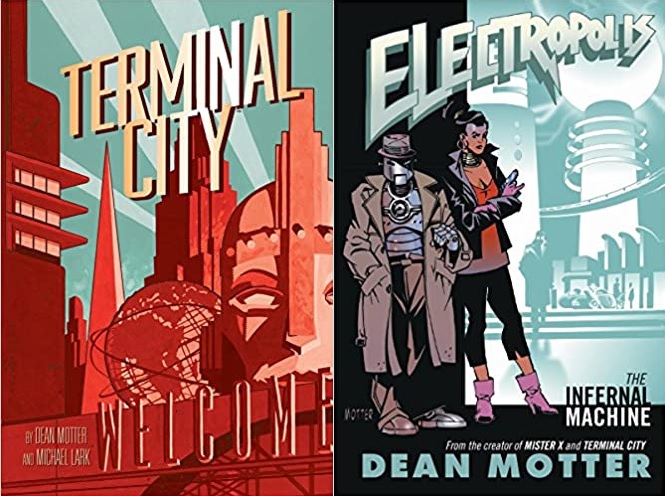
Sometime after the Mr. X series was published, Dean Motter published 2 unofficial sequels. Terminal City (released sporadically in the middle 1990's) and Electropolis (which was released in the 2000's). While this is considered by Motter fans to be a trilogy, the stories aren't really connected. The latter books are at least peripherally related to Mr. X and Radiant City as they take place in the same universe, but don't really further the story of Mr. X. Terminal City is a bright spot in the overly grim, overly drawn, event-driven comics of the 1990’s. This work is such a breath of fresh air, an alternative to superhero comics of the time. Terminal City is the purest vision of Dean Motter’s retro-futurism. This series melds Bruce Timm’s Gotham City and Asimov style sci-fi into a loose story about aging daredevils and a mysterious briefcase. This is a world where old art deco buildings clash with futuristic ones, where robots and flying cars mesh with old time gangsters and where gorgeous femme fatales try their damnedest to take advantage of unsuspecting men. The plot is kind of zany, involving a crooked mayor, a crooked industrialist, land schemes, missing and legendary crown jewels, a naive newcomer to town, and an old boxer. The hero is Cosmo Quinn, former "Human Fly" daredevil turned window washer, but the Grand Hotel-like plot jumps between multiple stories and characters. Readers will catch references and homages to old noir films, Abbott and Costello, and even Tintin. The art by Michael Lark is straightforward and easy to look at, while the colors and vivid and expressive. This is recommended if you like noir-ish shadows melding with technology in a way that the cyber-punk genre may have attempted but never fully succeeded in delivering the way this does.
The later story, Electropolis, features Menlo Park, a reprogrammed janitor robot working as a private detective on the neon streets of Electra City, a sister-town of Radiant City, that's been designed to generate and conduct massive amounts of electricity. Sixteen years after the apparent suicide of his human partner atop the world's tallest tower, a blond femme fatale gives Menlo some new information about the cause of death. As Menlo and his assistant, Anesta, reopen the case, their journey takes them from Electra's high society to its dark underbelly. Of these 3 stories, it is the weakest, if only by default because the other 2 are so good. Of the 3 however, this feels the most straight forward and is more like an old film-noir plot than anything else. Motter handles the art chores here and delivers some great panels. Definitely recommended.
Sunday, April 11, 2021
Frank Robbins Deserves Credit For Helping Create "The Dark Knight"
Sunday, April 4, 2021
Superman Smashes The Klan! - A Comic Review and Analysis of Superman Vs Hate Groups
Superman Smashes the Klan! And he's been doing so for about 75 years. The Man of Steel first encountered the KKK in his very own radio show in the 1940's. It seems that every generation or so, DC Comics publishes a story dedicated to Superman fighting either the Ku Klux Klan directly or some group that was indirectly inspired by what the Klan represents. In that way, Superman has never completely lost that sense of truth and justice that Jerry Siegel and Joe Shuster gave to their character. He has always remained something of a social crusader.
It began in 1946. The Anti Defamation League had infiltrated the KKK. The ADL contacted the Superman radio show and suggested that they feature a story where the titular hero faces the Klan. Over 16 episodes, from June to July of '46, "Clan of the Fiery Cross" aired and Superman took his war to the fascist menace.
And as for the comic? Well, this story is a new take on the saga that is the "Clan of the Fiery Cross." In the 3-part miniseries, written by Gene Luen Yang with art by Gurihiru, Superman is in his younger days. He helps an immigrant family, battles racists, and finds himself grappling with life as an alien outsider. Like the radio show from which it drew inspiration, the story takes place in 1946.
The story seems to take a lot of inspiration, not only from the radio show (even The Atom Man appears), it is visually inspired, at least in part, by the Fleischer cartoons. It's a brisk story with appropriately cartoony art, that seems to offset and balance the seriousness of the subject matter. This is a great ode to Superman's Golden Age. It's also very topical, considering the times we live in. What I like most about this story is that it squarely defines the KKK and their sympathizers as the enemy. Superman has some of that hutzpah, here, that he had in his earliest days. The Champion of the Oppressed has returned and... if there was ever a time for him... the time is now! Thanks, Superman, for fighting fascism and taking it to these bad guys! Recommended for all ages. This is a masterpiece and should be read again and again.