Showing posts with label TV shows. Show all posts

Monday, November 15, 2021

Justice League (2001-2006) - Review and Analysis

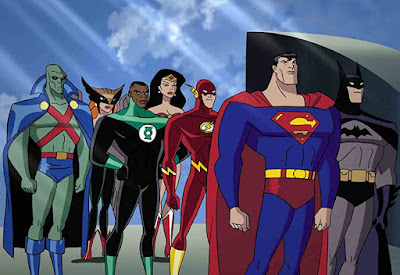
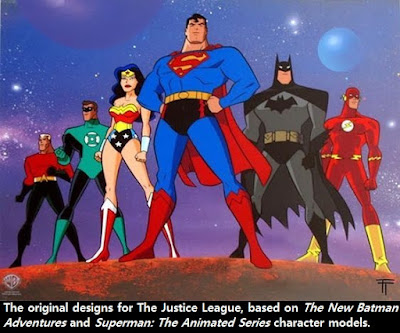
In the late 1990's, thanks to the success of the Batman and Superman cartoons, Warner Bros. Animation decided to proceed with plans for a Justice League cartoon. There were many ideas floated around the offices of Warner Animation about how to bring the show to life. First and foremost, Bruce Timm and his team would be the showrunners, for obvious reasons.

The show was originally going to feature the classic Silver and Bronze Age versions of The Justice League. Barry Allen was set to be The Flash, Hal Jordan was going to serve as the show's Green Lantern. Hawkgirl was not going to appear and John Stewart was only supposed to make a cameo appearance. Aquaman was also meant to be a main character. The producers abandoned that approach as they thought it would feel like an extension of the old Super Friends cartoon. More diversity was desired and they wanted the show to feel modern. So, Hal and Barry were deleted and they brought in John Stewart (who was more brash and aggressive than Hal) and Wally West (who was considered by Bruce Timm to be younger and cooler than Barry). Hawkgirl was added for more female representation as well. Martian Manhunter, the alien known as J'onn J'onzz, was originally set to make only a few cameo appearances in a couple episodes. The producers felt, since he was a founding member of the team, that J'onn  should be part of the main cast.

Justice League debuted to much fanfare on Nov. 17th, 2001 on Cartoon Network. The show was clearly an extension of the DC Animated Universe and all the characters were faithful to their comic book counterparts. Kevin Conroy returned as the voice of Batman but Tim Daly was replaced by George Newburn as the voice of Superman. 

The great thing about this show is, because of the ensemble cast and their differing traits and characterizations, a diverse set of plots and adventures could be had. Wild science fiction stories could be told along with the more grounded crime fiction shows. Because it's a team show the character interactions are what make it special. We get to see how each of the main characters approach their roles as superheroes and how they sometimes clash with their teammates. 

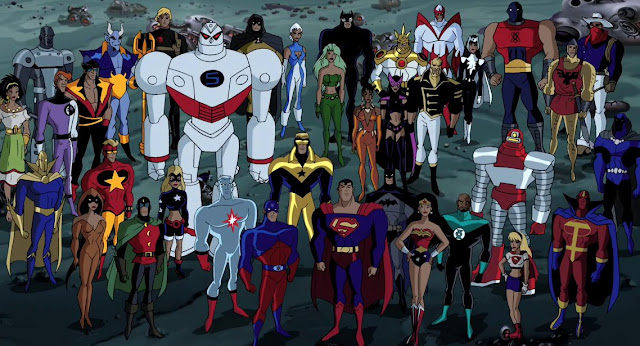
In 2004, the show was rebranded as Justice League Unlimited (abbreviated to JLU). Bruce Timm has famously said that the final episode of season 2 was supposed to be the finale but, because of high ratings, Cartoon Network ordered more episodes. Rather than continue on with the same show, Timm and his producers decided to make a new show that was based on those first two seasons. Rather than simply show the Justice League in more cartoons, the new show would feature an expanded cast from all corners of the DC Universe.

The new cast included the original show's stars but now featured Green Arrow, Black Canary, The Question, The Huntress, Supergirl, Booster Gold, and Captain Atom, among others. Justice League Unlimited was a broader show than its predecessor with many multi-part story arcs. It continued to explore the main characters motivations but also seemed more operatic in scope. The fun sense of adventure and banter between the characters remained but I think the new show told better stories. A fun thing for any DC Comics reader to do is to watch the show and see how many tertiary characters you can spot. I always remember seeing some of my favorites (like Swamp Thing) appear briefly in the Watchtower (the Justice League satellite headquarters).

In many ways, this is my favorite superhero cartoon based on DC characters, even if I revisit it less than BTAS or Superman. The expanded cast and the expertly crafted writing and dialogue shows that Bruce Timm, Paul Dini and the other producers really understand these characters and the world they inhabit. Justice League was a great team-up show with a lot of heart. JLU was all that and more, telling deeper, more layered and dramatic stories while still managing to be fun. I know this is a beloved show and I highly recommend it as well. It's reputation is well deserved.

Tuesday, October 26, 2021

The Flash (1990) - Review and Analysis

The Flash debuted in 1990 on CBS as TV's answer to the 1989 Batman film. It started life as a treatment for a superhero show in 1988. The project, pitched by executive producers Danny Bilson and Paul De Meo, was called Unlimited Powers. The premise followed a team of four superheroes (The Flash, Green Arrow, Dr. Occult, and a man made of rock called Block) that would cease using their powers by government order after the U.S. and Russia created a "Limited Powers Act" to help promote world peace. The Flash would be one of those heroes and would refuse to give up his powers. CBS loved the idea of a superhero show but told the producers to use only one hero because of cost concerns. 

Bilson and De Meo chose The Flash. There was a problem though. DC wanted to promote Wally West as The Flash because, by 1990, Barry Allen, the 2nd Flash, had died in the Crisis On Infinite Earth's saga that closed out the Bronze Age. Wally was formerly Kid Flash, Barry's sidekick, but the producers hated Wally as The Flash. So, compromise was reached. This new show would use Barry Allen as The Flash and combine the character with aspects of Wally. Barry Allen, the police scientist, would have Wally's red hair and need to eat a lot of food to maintain his metabolism. They also wanted the show to be dark, urban and dramatic. They used the Batman movie as a template for how the show would look. Art-deco buildings and vintage cars were merged with current technology to give the series a timeless quality.    
The search was on for a great cast. Bilson and De Meo tested more than fifty actors for the lead role. Eventually, John Wesley Shipp, an Emmy award-winning soap opera star, was cast. He didn't know anything about comic books or The Flash and had to do a lot of research. At first, when he was told about the project, he declined, as he didn't want to be seen in tights. After reading the script, he was impressed enough to audition. Shipp has a lot of charm as Barry Allen and plays the role with such confidence and sincerity that you constantly root for him. This is how a superhero should look and act on screen. 
Amanda Pays was cast as Tina McGee, a scientist and love interest for Barry who was then Wally's girlfriend in the comics. Alex D
ésert played Julio Mendez, a character created for the show, that served as Barry's lab partner. While both Amanda Pays and Alex Désert are fun to watch, they lack the charm of a well-rounded cast when compared to later superhero shows like Lois and Clark but, if given enough time to develop I'm sure they would have been stellar.
One of the special and most remembered things about this show is the Trickster cameos, played famously by Mark Hamill, before he became even more famous for his role as The Joker on Batman: The Animated Series. Here, Mark Hamill has fun in his role as the psychotic villain and, by his own admission, he even lobbied for the part. The Trickster episodes are some of the most fun episodes of the series entire run. 
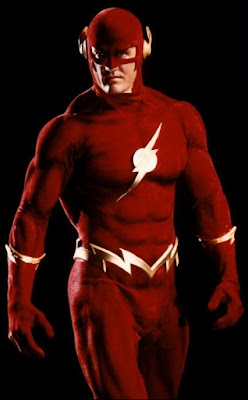
Famed comics artist and Rocketeer creator, Dave Stevens, drew the concept art for the Flash costume. 
The costume was a driving force in getting the show off the ground because, without a credible costume, this show wouldn't be taken seriously. Having seen what Warner Bros. had done with both Superman: The Movie in the 1978 and taking cues from the then-new Batman film, Bilson and De Meo knew that the Flash suit could make or break the series. They knew they didn't want spandex as it wouldn't accentuate the human form or offer a heroic look. They also wanted to deliver a movie quality superhero costume on a TV budget. After wrestling with CBS, who wanted The Flash to wear a gray sweatsuit without any superhero motifs and no mask, Bilson and De Meo compromised. They would get the red Flash costume that they wanted, but The Flash couldn't wear any yellow boots. 
So, after enlisting award winning costumer Robert Short, famous for his work on Star Trek: The Motion Picture (1979), a prototype costume was created out of latex. They used various techniques such as flocking, sculpting, and painting to create a suit with a unique muscular texture. Eight suits were made at a total cost of nearly $1 million USD. The suit itself was very hot and claustrophobic to wear. John Wesley Shipp lost some weight in the suit at first and considered seeing a shrink for his claustrophobia until accommodations were made. Cooling vents were installed in the suit to keep the actor cool and his time in the suit was more limited. As difficult and expensive as it was to bring the Flash suit to screen, it looks amazing for 1990 and, in my opinion, remains one of the best superhero costumes ever produced for any production.

After six weeks of filming (and nearly $6 million), the 90-minute TV pilot debuted on September 20th, 1990 and was a resounding success. The show ran for a season but after twenty-two  episodes, the series was not renewed for a second season. That's most likely because of it being an effects heavy show, expensive to produce, and it faced stiff competition in the form of The Simpsons and The Cosby Show. It's a real shame that this show wasn't renewed because, by all accounts, the second season was supposed to be even more effects heavy with a bigger budget. The season two pilot was supposed to be a two-part feature that had multiple classic rogues of The Flash in a plot to take down the Scarlet Speedster. 

Once the dust settled, multiple episodes of this series were edited together for three direct-to-video movies. The Flash (1990), The Flash II: Revenge of The Trickster (1991), and The Flash III: Deadly Nightshade (1992). Later still, John Wesley Shipp (and a few of his fellow cast members) returned to the new Flash show in 2014. Here, Shipp played Barry Allen's dad, Jay Garrick (the Golden Age Flash), and even cameoed as his own character, The Flash, in a crossover episode with Arrow and Supergirl. 
This show is fondly remembered by many older superhero fans and Flash fans. For fans of the newer Flash series, this might be a welcomed surprise. It's a fun watch with a lot of heart. Highly recommended. 

Wednesday, October 20, 2021

Lois and Clark (1993-1997) - Review and Analysis

Debuting in 1993, Lois and Clark: The New Adventures of Superman was a television show that attempted to further the Superman legend by injecting romance into its super heroics. It ran for four seasons on ABC and followed the immediate Post-Crisis comic book continuity established by John Byrne et al. This was the first incarnation where Clark was the real identity and Superman was just a heroic persona.

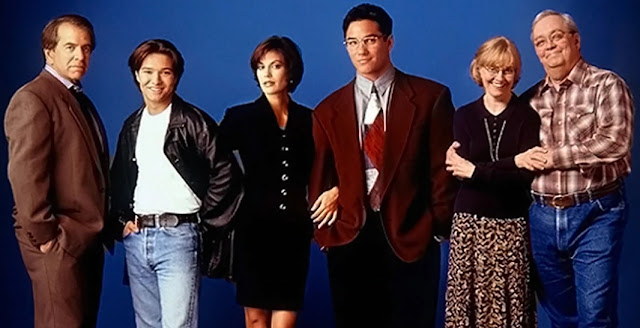
Lois and Clark is a very entertaining show. The first season is the best, largely because of the dynamics between John Shea's Lex Luthor and Dean Cain's Superman. The plots of the show vary greatly. Action heavy stories give way to suspense. There's occasional cheesy comedy to balance out the romantic drama between the title characters, but it's the romance that really drives the show. The best episodes, for me, are when Superman's humanity is explored. The chemistry between Teri Hatcher and Dean Cain really draws you in and keeps you invested. The magic of the show really comes down to the cast.

Dean Cain is the best live-action Clark Kent ever. His Clark is the most fleshed out of any live-action version. Every time he is on screen he just exudes charm... Cain's Superman however, while very serviceable for a romantic adventure show, left a lot to be desired because there was very little to distinguish Cain's Superman from his Clark. For my money, the best Superman still is Christopher Reeve.

Teri Hatcher delivers the definitive portrayal of Lois Lane. She defines every one of Lois' traits perfectly... the tough, brash, no-nonsense reporter. She's also very charming and sexy. If any of the other Lois' compare to her, the one that springs to my mind is Dana Delaney from Superman: The Animated Series in the 90's. Teri just nails Lois Lane perfectly.

Lane Smith as Perry White is just a complete character. Lane's Perry is very likable, funny, charming, and a genuinely good person who cares about his reporters. He's got the Elvis obsession that comes from the modern Perry from the comics. While I like John Hamilton (from the 1950's Superman show) and Jackie Cooper (the Reeve movies) in their roles, they don't get the rounded character of Perry as much as Lane Smith does. To be fair though, Lane Smith had four seasons to develop Perry into a real character.

Then there's Jimmy Olsen... Michael Landes did a good job with what he was offered but didnt get enough time to shine. He was good in the role but had he been given more time to develop, he probably would have been great. When I think of Jimmy Olsen, it's Justin Whalin that I think of. Whalin gave us the Daily Planet photographer as I'd always wanted to see him... curious, mischievous, a modern teenager.

Eddie Jones and Kay Kalin were great as The Kents. They seemed like the kind of parents (or grandparents) that you'd wanna have... just two very genuine and caring people... not too bland and old fashioned either, which was nice; a modern update on Ma and Pa Kent.

And now we come to my favorite part of the show: John Shea. His Lex Luthor was absolutely the most vile character and the perfect Lex Luthor. Arrogant, charismatic,  narcissistic, and evil. His hatred for Superman is fiery. There were moments in that first season where he scared me. John Shea is the best Lex Luthor in live-action. He gave an absolutely stunning performance. No other Luthor compares in my mind, though Clancy Brown's Lex is the best animated version.

Tracy Scoggins as Cat Grant was interesting. Rather than giving fans the character from the books, they rewrote her as the office gossip. Tracy was great in the role, even if it was a different character. They axed her after the first season and she deserved better. They could have given her a credible exit, at the very least.

I also liked the character of Jack from Season 1 and would have preferred if he'd stuck around for the rest of the series. He was a cool addition to the cast.

Beyond the cast is the writing and production design. Lois and Clark features pretty conventional writing for a 1990's superhero TV series that turned into a romantic comedy/drama. The plots are fun and try to juggle human drama, light comedy, and comic book/sci-fi themes. Even if the budget doesn't always allow for the greatest effects work, the show holds up. I also think the production design was stellar. Dean Cain's Superman costume looked great on screen and every setting, from the Kent farm to the Daily Planet, even Luthor's penthouse, was spectacular. 

Lois and Clark is a charming show that leaves a romantic mark on the Superman mythos. It's dated by today's TV standards but is a fine addition to the Superman franchise. I personally find it more enjoyable than shows like Smallville and Superman and Lois because I'm not interested in a teenaged Clark or Superman with children. I'd recommend this show to any Superman fan or anyone who wants to see where Superman was at in the 1990's.

Wednesday, February 3, 2021

Galactic Guardians Presents: The Fear

I have been spending a lot of time lately watching various episodes of Batman: the Animated Series. The show is, of course, so good that it got me thinking about Batman's history in cartoons. Batman debuted in cartoons during the 1960's thanks to the now infamous company, Filmation, as part of the Batman/Superman Hour. The Batman bits of that show eventually got repackaged as The Adventures of Batman. This of course led to the better known ABC broadcast, Super Friends, in 1973 that lasted until 1985. Batman had a starring role in the Super Friends series, which was animated by Hanna-Barbera. A short-lived cartoon ran concurrently with that called The New Adventures of Batman. 


The
final season of Super Friends got rebranded for ten episodes as The Super Powers Team: Galactic Guardians. Pre-BTAS, this is the most serious that superhero shows ever really got. Which brings us to The Fear!    

This screenshot from The Fear shows the first ever "dark" Batman in animation.

The Fear
is the first time ever, outside of comics, that Batman ever got dark. Of course, it wasn't as dark or sophisticated as anything that Bruce Timm and Co. would give us in the 90's but, for 1985, this was well done. They couldn't really do anything beyond the level of  cartoons for 8-year-olds because Standards and Practices in children's animation back then was far more conservative. The Fear raised the bar for superhero cartoons and is probably the best DC superhero cartoon made before the 1990's.

Here, Batman is terrified of Crime Alley, the place where his parents were murdered. The Dynamic Duo chases Scarecrow and his Strawmen (because, what else would you call Scarecrow's henchmen, LOL) towards Crime Alley but once Batman realizes where he is, he freezes. Scarecrow gets away and Batman and Robin spend the rest of the episode dealing with his trauma and the Scarecrow tries to exploit his fear. At a party at Wayne Manor, Diana Prince (Wonder Woman) shows up and notices Bruce is not his usual self. At the end, the rest of the Super Friends show up and help Batman work out his trauma so that he and the Boy Wonder can stop Scarecrow's scheme. 

This is 21 minutes of superhero storytelling that rivals some of the darker toons that came later. Granted, this is still a kid's cartoon, and, when watched today might seem simplistic, but it's still important. It's the first time in animation where Batman is more than one dimensional and his humanity is explored. The episode is a gem in a series of otherwise saccharine and campy cartoons. Alan Burnett, producer of BTAS and other shows in the more modern DC Animated Universe also wrote this episode. He was one of the main writers on the Super Friends show. 

Because of the Super Friends legacy, the history of Batman in animation is really pretty weak until BTAS. That said, The Super Powers Team: Galactic Guardians is a fairly watchable, and sometimes entertaining show. The Fear remains its best episode and is a neat little artifact for fans, new and old, to discover. Anyway, I just discovered it and for those who have never heard of this episode, I highly recommend it for all Bat-fans!

Saturday, August 1, 2020

4Kids TMNT (2003-2010) - Review and Analysis


The 4Kids TMNT series premiered on February 8, 2003 as part of  the FoxBox programming block (later branded as 4Kids TV) and ended on March 27, 2010. It was produced by 4Kids Entertainment in conjunction with Mirage Studios, and spearheaded by Lloyd Goldfine with significant input and approval by Peter Laird himself, co-creator of the TMNT.

Since Laird was so heavily involved throughout production, seasons 1-4 are probably the “purest” versions of the property outside of Mirage. In fact, the series is so Mirage inspired that seasons 1-4 are probably the best way to get a grip on what Mirage made without actually reading the comics themselves. Unfortunately, The stories for seasons 5-7, Ninja Tribunal, Fast Forward and Back To The Sewers are quite heavily removed from what came before, as the animation changed, characters were redesigned and the stories were less engaging. That said, season 5, the Ninja Tribunal Saga, is the best of the latter series.

The 2003 show was markedly different for mainstream, non-comic book, audiences because up to that time the turtles were remembered most as a childish, goofy cartoon of the 80's and 90's. And, again, while this show took a lot from the Mirage comic books, it is not a direct adaptation of those comics, because it never attempts to capture the grit and darkness that the original comic series had. It does however adapt several issues into episodes, so, in spirit, it is, as much as American children's cartoons can allow, the most faithful version.

The magic of this show is that it was able to blend the humor and wit of the 1987 cartoon with a more mature tone. The character portrayals were a very faithful blend of the Mirage turtles, the 1990 movie turtles and the 1987 turtles. Their take on The Shredder, however, was a new idea created specifically for this show. Firstly known as ninja-master Oroku Saki, as he was in both the original comics and the 1987 cartoon, he was later revealed to be an utrom alien known as Ch’rell. This revelation bugged me a lot at first, but later grew on me. Utrom Shredder works well for this series, but I would have preferred if he had remained a human ninja master. April not being a reporter confused me at first as well, but now, knowing the source material, I prefer her as the computer scientist/former assistant to Baxter Stockman.

There were also other major characters introduced for this show. Bishop, government agent for the E.P.F. (Earth Protection Force), Hun, leader of the Purple Dragon gang and eventual enforcer for The Shredder, as well as Angel, friend to Casey Jones. Each of these characters would go on to play major roles in the IDW comics and also appear in the later volumes of Mirage. Karai, the high-ranking Foot Clan assassin that debuted in the Mirage Comics City At War storyline, also appears here.

I remember watching a couple episodes as a teenager when this show aired but by the early 2000’s I had long been out of TMNT fandom. By the time I rediscovered TMNT and saw this show again I was blown away at how different it was from the turtles of my early childhood. When I later discovered the Mirage books I saw exactly how faithful a lot of this cartoon was to the source material.

The music of the show was very well done and fit the mysterious, action-oriented and sci-fi aspects of the show well. The majority of the show's soundtrack consists of moody oriental theme music. It's very fitting for a show about ninjas. Lighter musical cues signal when the show needs to be humorous. Occasionally, there will be lyrical songs sung during brief bits of action that give certain episodes a fun "teenage" flair too.The most annoying part of the show, however, is the opening theme, a hard-rocking piece of Saturday morning fluff that introduces the character and plot. It really undermines the otherwise mature nature of the show. In fact, once you've heard it about ten times it becomes unnecessary and painful to hear again. 

As of this writing there have been 4 cartoons. I would consider the 2003 4Kids Series to be the truest representation of what the franchise is outside of the Mirage comics. The show’s humor, action, maturity and characterization sets it apart from all other TMNT cartoons and makes the show feel less like it’s aimed at kids (despite the name of the production company) and more like it’s an all-ages show. It even went on to inspire the overall tone and atmosphere of the newer IDW comics too. My wife and I still try to binge watch this show at least every couple years, but we only really watch the first 5 seasons because the final 2 seasons were a major departure. If you’ve never seen this show, I would recommend watching it, particularly the first four seasons, and give the 5th season a try. It will forever remain a treat for ninja turtle fans.

Thursday, July 16, 2020

X-Men: The Animated Series


X-men: The Animated Series debuted on October 31, 1992, in the U.S. on the then new Fox Kids Network. This show holds a special place for me as it was my first exposure to any Marvel property ever. I was already familiar with Batman and DC through the 1989 Batman film and Superfriends reruns but had yet to encounter the wonderful world of Marvel superheroes. Not long after seeing this show I visited a toy store and stood in awe of the action figures for this cartoon displayed with the older Marvel action figure toy lines. Being about six years old, I had no clue what this cartoon would ultimately be responsible for. Very soon, I would start reading Marvel comics and, like millions of other kids, fall in love with their line of heroes.

It was this show, and later Spider-man, that cemented my worldview of Marvel Comics characters and what they should be. These cartoons are the biggest reason that the X-men are some of my favorite comic characters.
 It was much later that I discovered that this version of X-men was Marvel’s 2nd attempt to get their mutants off the ground. Pryde of the X-men debuted as a pilot episode in 1989 for what was supposed to be a new wave of Marvel animation. It was a massive failure but what I love about that single episode is that Kitty Pryde was the main character. She’s one of my favorite X-men. I also enjoy the appearance of Allison Blair, The Dazzler. Colossus and Nightcrawler were also part of the team, which was nice for any 80’s X-fan. This cartoon presents the classic 80’s X-men team (my favorite X-men era) and it gets their look completely right. The story was also good, hitting several notes from the Chris Claremont/John Byrne run. Unfortunately, the animation was poor and Wolverine was apparently Australian, something that the comic books flirted with for a time before Logan officially became everybody’s favorite Canadian.

The 90’s show took inspiration from Jim Lee’s redesigned X-men from the early 90’s with its character designs. Those designs were current and popular at the time. The team is comprised of the X-men’s Blue Team as featured in the early issues of X-Men Vol. 2. Cyclops was the leader, just as he had usually been in the comics. The cast was rounded out by Wolverine, Beast, Jean Grey, Storm, Rogue, Gambit, Jubilee, and Professor X, as well as a new character created for the show, Morph (an outgrowth of the Silver Age X-Men character, The Changeling).

The show’s main musical theme, a distinctive and heavy guitar instrumental written by Ron Wasserman, was featured in the original opening sequence where each of the X-Men demonstrate their mutant abilities for the audience. I remember early on being unable to decide who my favorite X-man was, because they all had such cool powers. It was usually a 4-way-tie between Wolverine, Gambit, Cyclops and Beast.

The influence that this show had on the X-men franchise can’t be understated. This show defined Wolverine for the 1990’s and remains the largest reason why Wolverine became so popular outside of the comics. I have no doubt that certain members of my generation will forever hear actor Cal J. Dodd’s voice as Wolverine. Even the movie people at 20th Century Fox used this show as their main creative influence on the direction of the movies. There’s even some conjecture that still persists about Hugh Jackman basing his portrayal in the movies largely on the Wolverine of this series.

Certain Marvel and X-men fans remember this show as fondly as most remember Batman: The Animated Series. Other fans don’t think it holds up as well, pointing out cheesy dialogue from characters, pretentious plots and poor animation. I fall somewhere in the middle of those two camps. I love this series and am still quite entertained when I watch it. That said, the subpar animation and outright animation mistakes, particularly in the 5th season (an almost entirely different show), can make certain episodes hard to watch. What should we expect with Marvel opting (as they did in all their 90’s animated shows) to use the hyper-detailed G.I. Joe model for animating their characters? Other things make this feel like it’s aimed at little kids too. The number of times Storm has to “summon the weather” is both annoying and hilarious. Wolverine’s constant rage against Sabertooth, and his constant jealousy over Jean Grey are also far too much to handle at times. Gambit also has a tendency to “charge” random objects with his mutant power, even when he’s not in battle.

Many of the classic comic book stories received adaptations that were either decent or taken completely out of context. The most notable adaptations were The Dark Phoenix Saga (the greatest X-men story ever written and a decent adaptation), Days of Future Past (Wait? Where’s Kitty Pryde?), Proteus (probably most accurate to the comic), and the Weapon X storyline (pretty intense for a kid's cartoon).

X-Men even crossed over with Spider-Man: TAS, when Spider-Man seeks out the X-Men's help to stave off his progressing mutation. Storm was even featured in later parts of that show when they half-heartedly adapted the Secret Wars storyline. These guest cameos made Spider-man: TAS feel like a sister show to X-men. This was amazing to a kid who loved both shows.

This series wasn’t afraid to deal with social issues. Topics include divorce, religion, feminism, and even the AIDS crisis. This was a double-edged sword however. While employing such socially conscious themes was admirable, this approach made the show feel a little uneven because, in other places, it also tried to display the typical Saturday morning humor. Being too self-serious and melodramatic while also trying to appeal to little kids often didn’t work very well.

X-men was followed by X-men: Evolution, a show that had more in common with the live-action movies than the comics. Later, Wolverine and the X-men, a show that seemed closer to the X-men comics of the 21st century than anything else, debuted to much fanfare. Both of these were very good shows, but not as all-encompassing, not as iconic and certainly not as fondly remembered by X-men fans as X-men: The Animated Series.

I still love this series, though how much of that love comes from my love of X-men comics and characters and how much of that love is based on nostalgia for this show, I’m not quite sure. Either way, I'm obligated to honor my childhood and view the series with some kind of love, but I have to admit, after a recent rewatch of the entire series, it’s simply not as great as when I was a kid.

Thursday, July 9, 2020

The Rise and Fall of The Simpsons: America’s Best Cartoon Sitcom


One of the things I often lament is that, living in the U.S., there's no real appreciation for animation or cartoons, at least not in the way other parts of the world value them. In some European countries (France is a good example) as well as much of Latin America and nearly all of continental Asia, animation is highly respected as a medium, and in some cases, worshipped. In some Asian countries comic strips and manga are even available in vending machines. By contrast, in the U.S., if almost anything is animated, be it a TV show or film, it automatically has a negative connotation by most adults and is branded as “kid’s stuff.” 

The Simpsons was one of the first American creations to shift that perception, even if we animation fans are still largely fighting that belief today. Things have improved with other, more adult, fare being released since The Simpsons debut, but I don’t personally believe much of it has compared in quality to this show, beyond things like South Park, Futurama or some of the Adult Swim programs.  Because of the right combination of humor, heart and satirical relevance, The Simpsons has gone on to become the most influential, and, perhaps the most important piece of American television animation ever created. 

The original Simpsons debuted in 48 short comedy sketches in 1987.

It all started when legendary producer James L. Brooks got his hands on Matt Groening’s popular underground comic strip, Life in Hell. He had originally intended to use its characters for sketch comedy, but Groening, not wanting to lose ownership of his comic strip, developed a sitcom family based largely on his own. The Simpsons first appeared in 48 short cartoons, usually 30 to 90 second comedy skits, which were used as bumpers on the ever-popular Tracy Ullman Show. These, in my opinion, are some of the best Simpons moments ever, and, have even been dubbed by some fans as Season 0 of the show. Fox, being in its infancy, was looking for something new. Impressed enough with the concept, the network ordered thirteen half-hour episodes. The characters were redesigned from their less crude models, fleshed out to better serve the half hour sitcom format, and on December 19th, 1989  the popular yellow-skinned family debuted with its own show, a Christmas special titled Simpsons Roasting on an Open Fire.

The Simpsons was an overnight sensation. The reason for the show’s rapid success is because it went against the grain and wasn’t afraid to push the envelope. Most television, especially sitcoms in the mid to late 1980’s, was quite bland, quite conformist and pedestrian. Other than The Cosby Show, most sitcoms were not overly popular. The 80’s brand of safe entertainment where nobody was offended or offensive seems, especially by today’s standards, incredibly boring and trite for any sitcom. People who were sick of the mid 1980’s sitcom formula, who couldn’t relate to those kinds of TV characters, suddenly found something to latch onto. The Simpsons were not a family with an overly successful doctor as the patriarch. They were rooted in the working class and the humor came from their everyday problems.

Some supporting characters are as memorable as The Simpsons themselves.

It was an amazing show for the first several seasons and parodied practically everything about late 80’s and 90’s American culture. The comedy was fresh, the jokes relevant and the characters were quickly becoming pop culture icons. The show seemed to work not only because Homer, Marge, Bart, Lisa, and Maggie were so funny, but the supporting cast and background characters were also memorable. Characters like Moe, the bartender, Chief Wiggum, Barney Gumble, Krusty the Clown, The Flanders family, Mr. Burns and Smithers, Bart’s best friend, Milhouse, Bart’s teacher, Edna Krabappel, Comic Book Guy, Sideshow Bob, and so many more, helped to round out the show and make the town of Springfield, with its mysterious location, seem that much more relatable.

By the mid 1990’s the show was firing on all cylinders. The unique cartoon gags like the rotating couch scene in the opening, as well as the contrasting personalities of the main characters made the show feel like it could do things that no other sitcom was capable of. It seemed The Simpsons unique brand of satire would endure for a long time and remain popular well into the new millennium. But then something happened. The show began to lose steam and the audience began to shrink. The show started to become something different than what it had been.


The unfortunate decline of the show, after the first decade or so, has come to be known as “Zombie Simpsons”. The exact moment when the show morphed from a smart, funny, fresh satire of American life to a show that lost its relevance is unclear. One thing is certain however, it has become an increasingly dim shadow of its former self. Some Simpsons fans put it at just after season 8, while others declare that the show got stale after the season 11 finale, “Behind the Laughter.” Some even cite “Behind the Laughter” as the show’s unofficial end. While many Simpsons fans have simply given up, the “Treehouse of Horror” anthology shows are considered the most popular episodes that have aired since the show’s apparent downfall.

And even though “Zombie Simpsons” has existed since about the year 2000, it’s not without its gems. Practically every episode of “Treehouse of Horror” remains brilliant. Every post-2000 season does bear some good episodes (a season 19th episode called “Husbands and Knives” is quite hilarious) but, most of the time, cultural references aren’t as funny, the satire is often less topical and the jokes sometimes don’t land as well as they should. A lot of the same plots are recycled and the character development has been nearly nonexistent in the last ten seasons. The show went from an exceptional sitcom founded on satire and character driven humor to an often bland comedy show, reliant on too many gags to get by. That said, it’s still far better than the kind of TV that was mediocre when the show debuted.

I think the reason the show has become "the sitcom that wouldn't die" is that it has a primary fan base that refuses to put it out of its misery. Deep down, fans, and probably the cast at this point, know it isn’t what it used to be but, out of some sense of loyalty, we just keep watching. Have most of the original fans given up? Probably not, but it has lost a large chunk of its audience.

The Simpsons is a show that helped define the 90’s. It’s THE show that made it okay for American adults to watch cartoons and it's THE show that finally broke TV fans out of the glut that was late 80’s sitcom mediocrity. But, that show hasn’t been around for a long time. In its place is something… different. Should “Behind the Laugher” (the final episode of season 11) have been the last word on Homer, Marge, Bart, Lisa and Maggie? In my view, no! I’ll agree that “Zombie Simpsons” is the “undead version” of a once supreme prime-time experience, but there are decent episodes still to be found. It fought against the grain and became a standout. Now, it seems to just limp along (in search of brains?), hoping that the ratings don’t force cancellation. And that’s sad because The Simpsons was a formative experience of my youth. I do like a lot of what came out after the year 2000 and, while I no longer follow this show like I once did, I will at least keep watching the “Treehouse” episodes as long as they are made.

Friday, May 3, 2019

Superman: The Animated Series (1996-2000)

* As I did with the FleischerSuperman cartoons and Batman: The Animated Series, I want to take a serious and analytical look at the Superman cartoon of the 1990’s.

       Superman: The Animated Series began life as a tie-in idea for the planned but never produced Tim Burton/Nicholas Cage Superman movie reboot. Once that film project started languishing, Warner Bros. handed the reigns of the cartoon series over to the producers and creative team from Batman. And why not? Batman: TAS remains the most successful superhero show of all time.

       Initially, Bruce Timm and company, while being excited at the prospect of working on the biggest superhero of all time, didn’t really know how to handle Superman. They weren’t sure if they wanted to go retro with Superman, ala Fleischer, or just follow the BTAS example. Ultimately, after many discussions and character sketches, the team decided on a retro-futuristic style for Superman. 

       The designs for the characters and their world were streamlined and more cartoony than even BTAS had been. The look was bright and optimistic, while certain episodes still harkened back to the pulp action/sci-fi tone of the best Superman comics.

       This series leaned heavily on the New Gods/Fourth World comics of Jack Kirby, introducing Darkseid and his planet Apokolips as major players. This was done because Bruce Timm believed that most of Superman’s enemies weren’t powerful enough to be any credible threat. Also as a result of this, as John Byrne had done in his comics, the producers felt it would be best to depower Superman from his all powerful Silver Age levels. This was a wise decision indeed. It’s much easier to appreciate and relate to a Superman who is less powerful than one who can blow out a star like a birthday candle.

       The other thing that this show also pulled from the Byrne comics was keeping the Kents alive. John Byrne had recognized the source of drama and the emotional anchorage that Jonathon and Martha Kent would add to Superman stories. This was an ingenious insight that the producers also accepted. It helped to make Clark more human and provide more of a background for him in Smallville.

       The score, once again the brainchild of Shirley Walker, is wonderful. The main theme is very heroic and optimistic. It feels like a Superman theme. Overall, this is a more modern soundtrack than the BTAS score. It’s less operatic, less sprawling and perhaps simpler. It helps the show feel much more like a science-fiction/fantasy cartoon than a dramatic superhero series. It would be impossible to hold this score up to the John Williams Superman theme. The two are incomparable, but both are brilliant.

       Many fans hold up this animated version of Superman as the best animated adaptation. While I agree that it's a fun show, I would have to give that honor to the Fleischer cartoons. While the animation for this series is technically near perfect for the clean, cartoony style that they went with, the stories themselves are hit and miss for me. Of the fifty-four episodes produced over three seasons, I would argue only about thirty-five of them, give or take a few, hit their mark. That said, this show still offers some of the best Superman media, outside of the comics.

       I realize there’s no such thing as a perfect show, and while some of the earliest episodes are truly brilliant, there are quite a few duds. This series simply lacks the pathos and more mature nature of the early BTAS episodes. The creators of this show also didn’t seem to take Superman as sincerely as they did Batman either. 

       There’s something about this show that just screams: missed opportunity. I can’t really put my finger on why, as much as I love this series, it feels like something’s lacking. Maybe it’s the fact that BTAS set such a high bar. Maybe, and this is just speculation, the producers ultimately didn’t know what to do with a Superman cartoon? Maybe it would have been better if the character designs and animation style were less cartoony? I don’t know. Even though I don't think this Superman show offers everything it could have, relying too much on either humor or Jack Kirby's 4th World, it still is a must for Superman fans.

       I still like a lot of what they did. Highlights for me include:

SEASON ONE
Episodes 1–3: The Last Son of Krypton (the pilot)
Episode 7: The Way of All Flesh
Episode 13: Two’s A Crowd

SEASON TWO
Episode 3: The Prometheon
Episode 4: Speed Demons
Episode 6: Target
Episode 9: Action Figures
Episode 12: Brave New Metropolis
Episode 16-18: World’s Finest (3 part Batman crossover)
Episode 22: The Late Mr. Kent

SEASON THREE
Episode 2: Knight Time
Episode 8: Superman’s Pal
Episode 9: A Fish Story
Episode 10: Unity
The Finale: LEGACY


Friday, February 8, 2019

Spider-man: The Animated Series


The Spider-man animated series that debuted from November 19, 1994 (1994-11-19) to January 31, 1998 was one of the highlights of my childhood. Sure, the animation was standard 90’s animation that Marvel used for all its shows, in the style of G.I. Joe, but the show felt smart. It created its own continuity and, for many young fans, myself included, was a gateway into reading Marvel Comics. 

While not as timeless or iconic as Batman: The Animated Series, this show offered a modern, fresh window into the Spider-man mythos. It was serious and compelling enough for older audiences but still entertaining for little kids. It is obvious that the producers cared enough to make the show dramatic and not just a formulaic or generic adventure cartoon. The use of CGI for the backgrounds of New York City showed that they were trying something different. I like the CGI segments, no matter how dated they may look today. And, even though the series played fast and loose with the comic book continuity, I appreciate the attempt to adapt some classic storylines. The spirit of the Spider-man comics was captured (particularly the comics of the 70’s and 80’s) with a 90’s flair.

The voice cast was stellar. Professional actors and veteran voice actors were used. To this day, when I read Spider-man comics, I am never able to separate Peter Parker’s voice from Christopher Daniel Barnes. For my money, even more than any of the live-action portrayals, Barnes delivered the most dramatic and best voice for our friendly neighborhood wall-crawler. Other classic portrayals included Roscoe Lee Brown as Wilson Fisk/Kingpin. That’s the voice I hear when I read his appearances in Spider-man or Daredevil. Ed Asner is also great as J. Jonah Jameson. Efram Zimbalist Jr. (the voice of Alfred on Batman) is the definitive voice for Doc Ock as well.

The music is also memorable. The classic main theme, a hard rocking composition performed by Joe Perry of the band, Aerosmith gets stuck in my head for days when I hear it. Shuki Levy, Kussa Mahchi and Udi Harpaz were the composers of the orchestral background score. The score is both fast paced, operatic and fun.

The show sometimes featured guest appearances by some of Marvel’s other well known superheroes.The most famous was the two-part crossover with the X-men show. The other great guest spots are the two-part Daredevil episode (my favorite episodes of the series), the episodes featuring The Punisher, the Doctor Strange episode and the ensemble shows toward the end of the series’ run that feature everybody from The Fantastic Four to Captain America.  (1998-01-31)

       The main problem with the show comes from a perceived censorship by fans, whether true or not. There has been conjecture by many that the series was heavily censored, even for a children’s television show. The series head writer/producer, John Semper Jr., denies this. Some tampering, whether by network heads or the Standards and Practices (S&P), has to be true, considering the use of laser guns, in most scenes, in place of realistic weapons, lack of realistic violence (Spider-man rarely throws a punch in the show) and replacement words such as “destroy,” “end” or “obliterate” for more threatening words like “death,” “murder,” or “kill.” Whether heavily censored or not, the tone of this series is so melodramatic that any censorship doesn't really take you out of the stories they are trying to tell. Also, the censorship sometimes works to the show's advantage. The laser guns in place of real firearms gives the show a distinct look. And because they hardly show Spider-man punching, his use of other maneuvers for attack, like landing on villains from above, holding them from behind, or the various aerial kicks he uses, seem creative instead of restrictive. Not being able to directly reference death also gives the show a kind of gravitas because when death or murder is discussed, they dance around it as if it is a serious issue.

      Of all the animated Marvel properties of the 1990s, Spider-man was the best (though X-men is a close 2nd place). Some fans may argue that the Spectacular Spider-man show of the early 2000’s is a better show. While I do also love that show, and find it to be a better show at times, it's this series that I watch more often. I think this series looks better and, at least to me, seems much more like classic Spider-man. Maybe this show shouldn’t have been any good, considering it was made for, or heavily marketed with, a line of toys. And sure, it’s a little dated, watching it 25 years later, but the series is just so fun and I lose myself in it every time I see it. The real shame is that, as of this writing, it still hasn’t been released in its entirety on any home media in the U.S. All in all, I love this series. Spiderman: The Animated Series will forever be my favorite adaptation of the webslinger outside of Sam Raimi’s Spider-man 2.