Showing posts with label comics. Show all posts

Tuesday, October 11, 2022

Captain Marvel Part 2 – I Really Love This Character!


So, after my Shazam review, I went back to my collection to read some Captain Marvel comics again. I came away with a realization: I’m a bigger Captain Marvel fan than I thought I was. I was always aware of the character peripherally and liked him, but after I re-read some Golden Age reprints of Captain Marvel Jr. and Mary Marvel, along with Jerry Ordway’s 1994 origin, and the Shazam: Greatest Stories Ever Told collection, I also realized that I need to hunt down more Captain Marvel. I love this character.


My other realization is that DC largely doesn't know how to handle him anymore. A term I’ve heard used to describe Captain Marvel recently is “zany.” Captain Marvel is not “zany" at all. He's a serious character in a fantasy world... "Whimsy" is a far better word to describe this character. Geoff Johns' New 52 take on him was not great. But that's not saying much, the New 52 wasn't kind to any DC character. DC has only really done a little bit with the real Captain Marvel, actually a separate character from Johns' "Shazam", since the 2011 reboot. The “Shazam!” version had a short-lived series in 2018 (again by Geoff Johns with artist Dale Eaglesham) and as of 2o22, Mary recently starred in a limited series, New Champion of Shazam!, that was pretty good, making her the new Captain Marvel/"Champion of Shazam"! DC has also used his real name, Captain Marvel, post the New 52 run which proves that DC has not lost all common sense. Somebody at DC gets it. There are writers and artists who are fans of Captain Marvel and understand his mythology. If only they could give fans an ongoing series that lasts, something that understands the characters as strongly as Grant Morrison's Thunderworld Adventures #1. I fear that, because of the moderate success of the Shazam! movie, that they're going to double down with that take on the character. I hope not. I hope that Captain Marvel can retain his fun, whimsical tone and have his true monicker restored.


I think, if you're a fan from way back, you'll find something to enjoy that’s Captain Marvel related up until the 2o11 Geoff Johns' stories. DC has done some excellent stuff with the franchise since the 1970s. Despite what C.C. Beck thought, the Bronze Age Captain Marvel run was pretty good, especially the work of Denny O'neil and E. Nelson Bridwell. The Roy Thomas/Tom Mandrake origin from 1987 was not bad as a story... just tonally confused and perhaps overly complicated. I think, if you like the New 52 Shazam!, that’s great! More power to you! I hope that run fosters a love for the character and inspires you to go back and enjoy the original stories, and then get into Jerry Ordway's stuff, and definitely check out Shazam! The Power of Hope.


Hopefully too, we'll get more Shazam reprints. I’d love a new edition of The Monster Society of Evil, the Golden Age story (perhaps with a disclaimer the way WB did with some of its old cartoons) … Depending on who you ask, this story may be the greatest Golden Age story ever written and drawn. I think it's one of the best, despite its racist and problematic elements. That's the problem with the Golden Age though, isn't it? By virtue of the fact that many superheroes debuted during World War II, and comic books were born in the late 1930s, racism, war propaganda, and rampant misogyny were pervasive. I still think it's essential for Captain Marvel fans to experience that story. The Jeff Smith retelling of that story has a large audience, and it’s a fantastic introduction to Captain Marvel for new readers, but, for my money, the Golden Age story is meatier and has a lot more to offer in terms of classic Cap stories and adventure.     


Of course, there are many fans today who only read modern comics. If that's the case, you can't really do any better than the Jerry Ordway run on Power of Shazam! It ran for 47 issues, plus one annual, which can usually be found in fine condition (or better) in comics bins for 50 cents per issue. 


For my money, the Justice League episode, Clash, is the best portrayal of Captain Marvel outside of comics. I also love the DC Showcase short with him in it. That's a Billy Batson that I want to watch! 

Say what you will about the movie, but the most positive thing to come out of it is that Captain Marvel is getting more exposure and is making new fans discover him and older fans, like myself, rediscover their love of the character and his world. Yeah, I like the Shazam movie for what it is, but am disappointed that it wasn’t faithful to Captain Marvel. Regardless of a movie misfire, only good things can only come from reading the adventures of Billy Batson and his family. 

Thursday, June 9, 2022

Defining the Ages!


In an effort to pin down the various ages of comic books, I recently conspired with some fellow fans online. I think we did a fairly good job of delineating the events that define the various ages, what it means for the industry and comic book history as a whole. While it may seem pointless to some—and impossible to others—to try to define the ages of comics, it can be fun to examine history and the trends that each age brought to the comics medium.

If 1938 is the starting point, with the publication of Action Comics #1—the first appearance of Superman—and the first comic book, it only seems fair to ask what came before? Well, as far back as the 19th century, adventure fiction came in the form of dime novels, stories featuring heroic protagonists—everything from private detectives and cowboys to swashbuckling pirates. After that came the pulp magazines, which gave us the superhero prototypes like The Shadow, Doc Savage, and Zorro. Superheroes like Superman are outgrowths of pulp heroes but also reactions to characters in the comic strips like The Yellow Kid (the first comic ever?), Thimble Theatre, Dick Tracy, and The Phantom (who is probably the first fully-realized superhero). The era that starts with the beginning of the comic strip and up until Superman has sometimes been labeled "The Platinum Age."

The Golden Age was an era when superheroes took on the role of moral crusaders, showcasing their spectacular powers and feats of strength in a wave of patriotic war-time fervor, a black and white worldview that defined the period. The superhero concept was successful for the first half of the 1940’s, but, after World War II, began to lose steam and die out. Superman, Batman, and Wonder Woman were the only characters to see continuous publication while the rest of the industry relied on westerns, detectives, horror, and romance (until the horror and crime books led to the Comics Code). Between the Golden and Silver Ages, there is sometimes a distinction... a roughly ten-year period (1946 to 1955) that connects the two... This is called The Atomic Age. Then, in 1956, editor Julius Schwartz, with Robert Kanigher and Carmine Infantino revived The Flash in Showcase #4. This is where the Silver Age began.


The Silver Age ushered in an era of worldbuilding with the revival of superheroes. Like The Flash, many Golden Age heroes got updated for the Atomic Age: Green Lantern, Hawkman, and The Atom. Heroes also formed a new team, an update on The Justice Society of the Golden Age, with The Justice League. This is the era that most modern superhero mythology is based on. This is where the DC Universe springs from. This is when the Marvel Age was born too, with the publication of Fantastic Four #1 in 1961, itself a reaction to DC’s popular superheroes. Marvel helped to solidify the Silver Age with its more developed storytelling and even bolder science fiction concepts, pointing the way to the Bronze Age.  


Even though superhero stories became generally more sophisticated by the late 1960’s, thanks to an influx of college-aged readers, the Bronze Age is usually recognized as starting in 1973 with a monumental death. Peter Parker’s girlfriend, Gwen Stacy, perished at the hands of The Green Goblin in Amazing Spider-man #121. This momentous issue seemed to signal a new trend in superhero storytelling: amping up the drama and pathos of the characters, their lives, and their world. Real world events began to shape comics even more and the age of social relevance was born. The landmark series, Green Lantern/Green Arrow by Denny O’neil and Neal Adams is the culmination of this. By the early 1980’s superhero stories were becoming far more engaging than they’d ever been, with titles like Uncanny X-men and the seeds of the Indie comics boom being planted, pointing to an era when the envelope would be pushed to even more intense heights.


The Modern Age is often cited as beginning with the publication of Alan Moore and Dave Gibbons’ seminal work, Watchmen in 1986. But the Modern age can be broken down into several distinct periods. 1986 to about 1992 is sometimes called the beginning of the Iron Age. 1992 through the late 1990's is often called “The Dark Age.” The stories of this period seemed to learn the  wrong lessons from the more sophisticated work of the 1980’s. The writing wasn’t as refined but the grit and edginess was aped in a shallow way. This period reflected a desperate attempt to be as relavant as the best known works of the previous decade but ultimately was an overblown, reactionary mess. It was a bad time for the industry, but there was still a lot of fun to be had. Marvels by Alex Ross comes to mind, as do the six oversized DC superhero graphic novels by Paul Dini and Alex Ross, Superman's triangle era, Hellboy, and Mark Waid’s Kingdom Come and Flash work.

Some have said that, in the early 2000’s, the Iron Age gave way to the Mercury Age. Are we still in that age? I don’t know, but I’ve often heard it said that we can’t define our current age historically until we're long past it. Either way, several shifts define the Post-Dark Age 21st century. Once the Marvel films started being made in the late 90’s and early 2000’s, the comics began to shift away from the grim-and-gritty era and become something new. Perhaps as a reaction to Watchmen and The Dark Knight Returns stories became decompressed. Decompression became the in vogue way of writing comics. Disney bought Marvel and gave birth to the Marvel Cinematic Universe (the MCU) which has arguably affected comics throughout the entire industry. Some call this the “Cinematic Age.”


In 2011, DC rebooted their universe again with the New 52 line, an ill-fated project that faded into the much better Rebirth era. Marvel has done several soft reboots too, as a reaction to DC but also as a way to make their comics more accessible to a larger audience. Comics seem to have now become an unbroken continuity of decompressed stories (with some exceptions of course),  shaped partly by the mass appeal of the film and TV adaptations and partly by the evergrowing popularity of the indie books. The Indie scene has had some fantastic successes like The Walking Dead and Saga too.


While the separation of the Golden, Silver, and Bronze Ages are generally agreed to come down to issue numbers and specific events/stories, the Modern Age doesn’t seem to have such clear markers. Perhaps there can be no definitive way to measure the modern period because it hasn’t been as clearly specified. It just seems too broad a period to define, so far.

Tuesday, January 11, 2022

DC Vs Marvel: A Look At The Big 2 Through the Decades


The Marvel/DC rivalry has become all the rage since the Marvel films started outperforming the DC movies in the last decade. Here, I'm gonna examine some comic book history, taking each company decade by decade, to try to determine who has made a bigger impact. 


For me, the 1940s belong to National Allied Publications (better known as DC Comics) solely because of Batman, Superman, Wonder Woman, and what would become prototypes for the DC stable, the Justice Society. Timely Comics (Marvel of the Golden Age) didn't have much great work beyond Namor, The Human Torch, and Captain America. The Captain America stories by Simon/Kirby are their greatest triumph, but reading them today, they get repetitive beyond the first few stories. Unlike the best Golden Age DC stories, the Timely books don't really compare. Sure, Timely had some interesting sci-fi concepts, but books like Batman, Superman, The Spectre, and Sandman were much better written. But outside the books, both companies started branding in other media. Superman and Batman got movie serials. Captain America got a serial. There were radio shows, toys, the Fleischer Superman cartoons, all kinds of merchandise. Superheroes exploded in pop culture and were everywhere.


Clearly the best publisher of the 50's was infamous publisher, EC Comics, but Atlas (as Marvel was known by the 50's) had some interesting non-superhero books compared to National, and given that all National/DC had was the Trinity for the first half of the decade (given that most superheroes had died out), 
I would love to give the 1950's to Atlas for the Return of The Human Torch and several good sci-fi/horror titles like Astonishing in the pre-code era. However, Julius Schwartz brought in Barry Allen as The Flash and the Silver Age began. It was the revival of superheroes, with a new Green Lantern, Hawkman, and The Atom. On top of that, DC editor, Whitney Elsworth, helped introduce The Adventures of Superman on TV, so National/DC wins for me.


The 60's goes to Marvel... for obvious reasons (the Marvel Age). The Lee/Kirby Fantastic Four run is still enjoyed decades later. Same with Lee/Ditko/Romita Spider-man. Even though National started to get better at the edge of the decade, their output during the 60's is not as fondly remembered as Marvel. There was still some great stuff. The New Look era of Batman debuted under the pen of Carmine Infantino. The Flash had some great stories too. Gardner Fox did some of his best work at DC during this decade, writing everything from Hawkman, Batman, The Flash, and The Atom. The Batman TV show debuted in '66 and became one of Batman's greatest legacies.   


I think the 70's is a close race. This is the era where DC became DC. Jenette Kahn came in (the best thing to ever happen to DC at the executive level). Titles like
Swamp Thing, the cementing of Batman as "The Dark Knight Detective", Green Lantern/Green Arrow all helped comics mature. Characters like The Spectre got modern updates, and Jonah Hex debuted. There was also the DC Implosion, where several shortfalls in sales led to a huge cancellation of several titles. On the plus side, DC jumped into TV and film with the Super Friends cartoon, the Lynda Carter Wonder Woman show, the live-action Shazam! show, and Superman: The Movie. Jack Kirby left Marvel for DC and introduced The New Gods. It really makes me wanna give it to DC but... Marvel's Spider-man began to evolve into what he is today. The Death of Gwen Stacy storyline ended The Silver Age and introduced The Bronze Age of comics. The Fantastic Four had several decent runs. David Michelinie and Bob Layton's defining run on Iron Man began here. This is also where Chris Claremont's Uncanny X-men started. 70's Marvel unleashed all of their monster books: Ghost Rider, Man-Thing, Morbius, The Living Vampire. Even Blade first appeared in Gerry Conway/Marv Wolfman's Tomb of Dracula... On TV, The Incredible Hulk show is remembered by a certain generation, and there was even a poorly received Spider-man TV series. I'll call this decade a draw.


The 80's is quite difficult for me too judge here, because it's my favorite decade of comics. Marvel has their trifecta... John Byrne on Fantastic Four, Walt Simonson on Thor, Frank Miller on Daredevil... Apart from that, Roger Stern (known as Uncle Rog to 80's Marvel fans) unleashed his masterpiece of a run on the various Spider-man titles. Comics got darker and more sophisticated in general around the time Frank Castle (The Punisher) got his own series. This was the era of black-suited Spider-man and Venom debuted in the David Michelinie/Todd McFarlane run of Amazing Spider-man as well. 1987 saw Peter David begin his fan-favorite run on The Incredible Hulk. Mark Gruenwald began his decade long run on Captain America. At DC,
New Teen Titans by Marv Wolfman and George Perez became one of the top sellers in the industry. Saga of the Swamp Thing by Alan Moore, Steve Bisette, and John Totleben debuted. The Crisis happened and DC rebooted their universe with memorable runs by John Byrne on Superman and George Perez on Wonder Woman. DC cemented the beginning of comics' grim and gritty era with the most famous stories of the 1980's: The Dark Knight Returns (DKR) and Watchmen. To cap off the 80's, Warner Bros. released Tim Burton's Batman movie. It's another draw.
The 90's as a whole is not a great decade for either company. By 1993, the art was starting to get overblown with big muscles, even bigger guns, and even bigger... well, you get the idea. Comics "Dark Age" was in full swing, an indirect result of what DKR and Watchmen did to the industry. Marvel was the worst of this. John Byrne's Iron Man run was good... Michelinie finished up his Spidey run with some solid stuff. But then Marvel became a joke. The X-men became convoluted. There were Spider-clones, and the company almost went bankrupt because of the speculator boom. That's not to say there weren't any bright spots. Marvels by Alex Ross was amazing. Mark Gruenwald's Captain America finished pretty strong and Mark Waid took over for a solid run. For my money though, Marvel's best stuff were their cartoons. Spider-man: The Animated Series was phenomenal. As was X-men. DC on the other hand, gave us event after event. Robin III (Tim Drake) was developed, after the death of Jason Todd in 1989. Bane broke Batman's back in Knightfall. Although not as guilty of chasing lame gimmicks as Marvel, DC still indulged in them. DC's saving grace was 3-fold. First: the "Triangle Era" of the Superman titles, a solid run of books that was an outgrowth of John Byrne's Superman revamp from the 80's. 2) The DC Animated Universe was launched in 1992 with Batman: The Animated Series. And 3) Vertigo was born in 1993 as DC's answer to the sophistication that comics had taken on since the Bronze Age. DC's events weren't as bad or frequent as Marvel's. All seemed overlong, overdrawn, and drawn out. The Death of Superman is the only DC stunt I have ever liked. It fits into a single omnibus for one thing. And it's aged well too. After that, Clark and Lois got married. On TV, Warner Bros. also gave us the Lois and Clark TV show, Superman: The Animated Series, and, on film, Batman sequels of varying quality. But Marvel also gave us the modern superhero movie boom with Blade. In my mind though, DC wins the 90's for better stories overall, including the best things they published that decade: Mark Waid's Flash run, and, DC's answer to MarvelsKingdom Come.


The 2000's is where Marvel's dominance begins. The comics got a lot better and the movies began to dominate. 2000's X-men owed almost everything to the 90's cartoon that catapulted the X-men into public consciousness. Of course, the Raimi Spider-man trilogy, the MCU, and the Spiderverse movie are all anybody really talks about from the Marvel of the last 20 years, but comics geeks know that Marvel has unleashed several great comics. Jeph Loeb and Tim Sale's "color books" and the Ultimate line of comics, the Civil War event, Brubaker's Captain America, and Mark Waid's Daredevil are great examples of how Marvel bounced back. 

Over at DC, their publishing side brought us Darwyn Cooke's New Frontier, All-Star Superman by Grant Morrison, and other gems that will stand the test of time. The DCAU continued with another masterpiece, the Justice League cartoon. The Nolan Batman movies were, overall, another feather in DC's cap. They finally filmed Watchmen, released in 2008, after decades of trying to film "the unfilmable graphic novel." It's a great film, but not a great adaptation. Perhaps DC's best and most consistent writer in this century has probably been Geoff Johns. He led a lot of DC's events (including another Crisis) and gave solid runs on The Flash and Green Lantern. As fun as a lot of the DC books and other media have been, I think when Jenette Kahn retired in 2002, DC lost a lot of footing. Paul Levitz was the next best thing for a replacement, the ultimate fanboy turned executive. Eventually, he stepped down and we got Dan DiDio. It was under DiDio that DC began to fall from grace. He hasn't been terrible, per se. He just didn't take the company to its previous heights. He did eventually unleash The New 52 to very mixed results. That got rebooted into Rebirth and somewhere between those two events, the DC Extended Universe, helmed by Zack Snyder, became a thing. Man of Steel (2013) is a fun film. Wonder Woman is the jewel in DC's movie crown. It's a masterpiece and the best DC film, in my opinion, behind Donner's 1978 Superman. The other pieces of the DCEU haven't been great, not bad... but not great. 2019's Joker is another story... not part of the DCEU, but a standalone character study. This film is absolutely incredible. It's not faithful to The Joker at all, but as a film, it shows that a comic book movie doesn't have to follow any formula. The 2000's goes to DC for its cartoons and Batman films. The 2010's are easily a Marvel win.

So, who wins? Who's been more influential on the culture? There can't really be an answer. They've both done great things for pop culture. They both have had major ups and downs. They've both offered incredible stories across all media. One is an unstoppable force. The other is the immovable object. They are eternal rivals, destined to clash forever like the great superheroes and villains that fans read about.    

Sunday, August 15, 2021

Popeye The Sailor Man!

Best known as a cartoon character from the 1930's and 40's and rebooted several times from the 1960's to today, Popeye was created in a newspaper comic strip by King Features Syndicate called Thimble Theatre, written and drawn by Elzie Segar.  The character would eventually grow so popular that he took over the strip and it was renamed in his honor.

The Popeye strip and cartoons showcase the adventures of a working class sailor named Popeye and his love interest, Olive Oyl (who was the main character in Thimble Theatre for ten years before Popeye debuted). The cast of characters is rounded out by the frequent antagonist, Bluto (later called Brutus when the cartoon was rebooted in the 1960's), the hamburger-loving, J. Wellington Wimpy, Geezil, the Cobbler, who made less frequent appearances, and the baby Swee'Pea (often pronounced Sweet Pea by the characters). 

Because of the popularity of the strip with readers, young and old, Popeye would get adapted into cartoons for both film and television. This started in 1933 with Fleischer Studios. Max Fleischer and Paramount Pictures saw such success with the Popeye cartoons that they ran until 1957. In the 1960's King Features Syndicate revived Popeye with a new series of cartoons.

The sailor's popularity expanded yet again into comic books, video games, advertisements for everything from spinach to candy cigarettes, and in 1980 was adapted for the screen in a live action film, starring Robin Williams.

The 1980 movie feels quite literally like an old Popeye cartoon in live action, though it has elements of the comic strip version of Popeye too. The performances are probably as faithful to the Popeye cartoons as is possible. Robin Williams translates the character to live action almost perfectly. The production design, sets, costumes and overall plot adapt the sailor and his world very effectively. It's a very entertaining film for its time and I enjoy it, but I have heard that some modern audiences criticize it for pacing.

One of the most frequent tropes of the Popeye cartoons is the love triangle between Popeye, Olive, and Bluto. Bluto serves as the rival to Popeye, who usually bests the large brute in a duel of wits and strength. While this provides a lot of humor to the stories, it separates the cartoons from the comic with a key difference: Bluto only appeared one time in the strip and the comic featured more complex plots than the simple love and rivalry of the cartoons. Also, in the comic strip, Popeye rarely ate spinach. The differences in the strip and cartoon have sometimes led to the perception that the strip was for all ages and the cartoon was more children's fare though it should be noted that in the 1930's and 40's people of all ages were entertained by cartoons.

The legacy of Popeye has been one of pure entertainment for young and old alike. The stories feature a character who is an odd mix of rough and tumble mariner, caring gentleman, and archetypal hero. Charles Schultz, of Peanuts fame, called Popeye "the perfect comic strip." In all media, in all his incarnations, the sailor's adventures offer a brilliant mix of adventure and humor with Popeye as the strongman archetype. In fact, Popeye was mentioned by Jerry Siegel as one of the early inspirations for Superman. Popeye has become so beloved that he continues to endure today, still published as a strip in several American newspapers, and new cartoons and animated movies still debut every few years.   

Wednesday, June 2, 2021

The Batman Runs by Grant/Breyfogle!


Starting in 1987, with Detective Comics issue #583, DC Comics unleashed one of the greatest creative team's to ever work on Batman! Alan Grant (with an assist by John Wagner on the first few tales) wrote some of the most memorable stories of the Post-Crisis era, precisely because they chose not to use many of Batman's main villains. They created new ones. And while it's debatable whether or not some of these villains are well-remembered today (Scarface/The Ventriloquist became a classic rogue), they were featured in some truly great stories, especially for the time they were published. Norm Breyfogle's art was unlike anything seen before. It was polished, detailed, and moody, yet at times expressionistic, cartoony and exaggerated.


The new creative team proved successful, only eventually, because the Bat-books at the time were suffering from lagging sales. But to make the indelible mark that they did on Detective Comics was no mean feat, considering they had to follow the excellent work of writer Mike W. Barr et al. 


What's so memorable about Grant and Breyfogle's run on Detective? New villains, The Ratcatcher, Cornelius Stirk, The Corrosive Man, Anarky, and the memorable Mudpack storyline (in which all the Clayface's were lead by Basil Karlo in an attempt to create one ultimate Clayface) were backed with other strange, pulpy plots. These tales combined with Breyfogle's unique and gorgeous art delivered something truly special to readers. They eventually did get to play with the standard rogues, The Joker, Catwoman, and The Penguin in some pretty fun stories also, resurrecting's Joker from his final appearance in the Death in the Family story. The run was a street-level, gritty, and at times socially conscious take on Batman's world. It remains a dark, sophisticated collection of stories that has a cultish appeal, and it's this run in particular that stands as one of the greatest runs of Batman comics ever. This Detective Comics run was presented in #583 – 597, #601 – 621 (1987 – 1990). 


From there, in 1990, the Grant/Breyfogle team moved to the Batman title. This run was more concerned with following and building on the established continuity of the period, something that Alan Grant regretted at the time. While this run did use more of the classic rogues like The Scarecrow, Catwoman, Maxi Zeus, and Killer Croc, the work was focused on helping to develop and establish Tim Drake as the new Robin and a plot in which Commissioner Gordon suffered a heart attack. Vicki Vale's role in Bruce's life was expanded upon and Sarah Essen was also further developed. It was the development of Tim and his backstory that ultimately makes this a memorable run of Batman books. This run went from #455 – 466, 470 – 472, 475 – 476, 479 – 480 (1990 – 1992). 

Breyfogle departed after Batman #480 and that was when the team produced what is perhaps their best work. They launched a new title, Shadow of the Bat. The first four-issue arc, The Last Arkham, featured a plot with Batman being put into Arkham Asylum and the creation of the now classic villain, Mr. Zsasz. 

Both runs certainly left their mark on Batman's history, but it's the Detective Comics run that remains a bright spot in the Batman canon. Alan Grant will forever be remembered for his wild, original plots and Norm Breyfogle's pencils remains some of the best artwork to ever grace The Dark Knight. These are must read Batman stories that I grew up hearing about, as a kid in the 90's, but never read in full until very recently. These comics remain personal favorites of mine and I highly recommend them.

**Note: Norm Breyfogle suffered a stroke in 2014 and passed away in 2018 due to heart failure. He was 58. Gone too soon, a true Legend of the Dark Knight! Rest in peace, Mr. Breyfogle, you were one of the greats!

Monday, May 10, 2021

The Neo-Noir of Mister X and the Radiant City Trilogy


Published by little-known (and now defunct) Canadian publisher, Vortex Comics, Mr. X was a wild idea. Bringing together the neo-noir/science fiction of films like, Blade Runner, with the pulp magazine sensibilities of the 1930's and 40's, it manages to weave together an intriguing mystery.

Written by Dean Motter with art by such luminaries as The Hernandez Brothers and Seth, Mister X tells the story of a mysterious character, a bald architect wearing dark glasses and a trench coat, haunting the streets and secret passageways of Radiant City, trying to piece together why Radiant City's architecture is driving its citizens mad. Mister X claims it is his job to fix things. He is a drug-fueled, paranoid, insomniac architect, obsessed with finding a cure for its people while going up against the city's corrupt officials.

But why him? Who is Mister X? The series doesn't really reveal his true identity until the end as the majority of the story is spent figuring out his motivations and tries to deliver clues to the mystery.


L
ike independent projects such as The Rocketeer, Nexus, Love and Rockets, and other classics of the 1980's, Mister X  is well remembered by fans of that era. When Mister X hit the comic book stands in 1984, it was truly a unique and inspiring vision. The story, artwork and interesting coloring choice was part film noir and part German expressionism, in the vein of the classic film, Metropolis. This book is just as good as the biggies of the 1980's: Dark Knight Returns or Watchmen, albeit not nearly as important. Mister X captivated comics fans and creators alike, but sadly, may not be known to present day comics fans. This is Dean Motter's best work. It can be held up as one of the comic medium's best stories ever told, in my opinion, though fans new to the medium or those acustomed only to modern comics may not appreciate it as much. Still, it's quite disturbing, violent, visceral and enthralling all at once. Amazing!


If you wanna check this out, it has been collected by Dark Horse Comics in an archived edition. Definitely a must read for any fan of pulp/sci-fi comics and worth collecting for fans of offbeat 80's comics. 


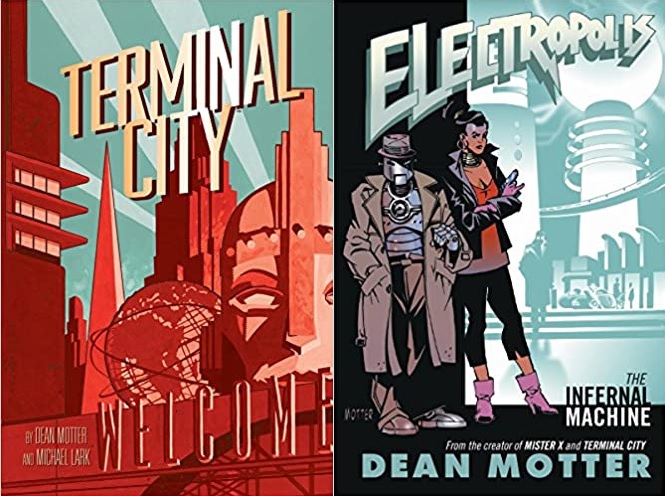
Sometime after the Mr. X series was published, Dean Motter published 2 unofficial sequels. Terminal City (released sporadically in the middle 1990's) and Electropolis (which was released in the 2000's). While this is considered by Motter fans to be a trilogy, the stories aren't really connected. The latter books are at least peripherally related to Mr. X and Radiant City as they take place in the same universe, but don't really further the story of Mr. X. 

Terminal City is a bright spot in the overly grim, overly drawn, event-driven comics of the 1990’s. This work is such a breath of fresh air, an alternative to superhero comics of the time. Terminal City is the purest vision of Dean Motter’s retro-futurism. This series melds Bruce Timm’s Gotham City and Asimov style sci-fi into a loose story about aging daredevils and a mysterious briefcase. This is a world where old art deco buildings clash with futuristic ones, where robots and flying cars mesh with old time gangsters and where gorgeous femme fatales try their damnedest to take advantage of unsuspecting men. The plot is kind of zany, involving a crooked mayor, a crooked industrialist, land schemes, missing and legendary crown jewels, a naive newcomer to town, and an old boxer. The hero is Cosmo Quinn, former "Human Fly" daredevil turned window washer, but the Grand Hotel-like plot jumps between multiple stories and characters. Readers will catch references and homages to old noir films, Abbott and Costello, and even Tintin. The art by Michael Lark is straightforward and easy to look at, while the colors and vivid and expressive. This is recommended if you like noir-ish shadows melding  with technology in a way that the cyber-punk genre may have attempted but never fully succeeded in delivering the way this does.

The later story, Electropolis, features Menlo Park, a reprogrammed janitor robot working as a private detective on the neon streets of Electra City, a sister-town of Radiant City, that's been designed to generate and conduct massive amounts of electricity. Sixteen years after the apparent suicide of his human partner atop the world's tallest tower, a blond femme fatale gives Menlo some new information about the cause of death. As Menlo and his assistant, Anesta, reopen the case, their journey takes them from Electra's high society to its dark underbelly. Of these 3 stories, it is the weakest, if only by default because the other 2 are so good. Of the 3 however, this feels the most straight forward and is more like an old film-noir plot than anything else. Motter handles the art chores here and  delivers some great panels. Definitely recommended.

Sunday, April 11, 2021

Frank Robbins Deserves Credit For Helping Create "The Dark Knight"

Frank Robbins is the only writer in Batman's history that has the distinction of being THE transitional Batman writer. Having taken over from Gardner Fox, Robbins worked on:
Batman #204–207, 209–212, 214–217, 219–222, 226, 230–231, 236, 246, 249–250, 252, 254 (as writer from 1968–1974) and Detective Comics #378–383, 386, 388–436 (as writer); #416, 420–421, 426, 429, 435 (as writer/artist from 1968–1973).

Batman fans often hear about how Denny O'neil and Neal Adams changed the character from the campy Caped Crusader into The Dark Knight. This is true, but it's a partial truth. Frank Robbins was writing and drawing Batman before Denny and Neal and it was his work that first brought maturity to Batman. He also wrote both flavors of Batman, campy and dark. As much as I love Denny O'neil, who I consider to be in the top 5 comic book writers of all-time, he and Neal (perhaps DC's greatest artist of all-time) cannot take, nor do they deserve, all the credit, despite what most popular blogs like IGN or CBR might have you believe.

Robbins' Batman stories started out in the same vein as Gardner Fox. They were simple, juvenile detective and mystery stories. About halfway through his run, he created Man-Bat with Neal Adams, and started the shift that marked the beginning of the transition from The Caped Crusader into The Dark Knight. In fact, Batman's appearance first changed, under the pencil of Neal Adams, in one of Robbins' stories.
He also wrote Batman #217 where Dick Grayson moves off to college and this forces Bruce to return to his roots, becoming, once again, the lone obsessed vigilante. Robbins also penned The Batman Nobody Knows, a short story from Batman #250. With art from Dick Giordano, this serves to illustrate that the Batman is a legend who is frightening to criminals. One of Batman's greatest stories, it was loosely adapted for both The New Batman Adventures episode, Legends of the Dark Knight, and as one of the shorts in the Batman Gotham Knight animated anthology film from 2008.
As much as Denny O'neil deserves credit for The Secret of the Waiting Graves (Detective Comics #395), which cemented the change in both focus and tone, without Frank Robbins to lay the stepping stones Julius Schwartz may never have hired Denny to write it. The record has to be set straight... Denny and Neal had a little help in creating The Dark Knight version of Batman. It was a recipe with many cooks, including other artists such as Irv Novick, and Jim Aparo. Robbins gets ignored by history just as, sometimes, Denny and Neal get casually ignored for bringing Batman back to his darker roots in favor of Frank Miller's 1980's work. But Frank Robbins is important to Batman too.

Sunday, April 4, 2021

Superman Smashes The Klan! - A Comic Review and Analysis of Superman Vs Hate Groups


Superman Smashes the Klan! And he's been doing so for about 75 years. The Man of Steel first encountered the KKK in his very own radio show in the 1940's. It seems that every generation or so, DC Comics publishes a story dedicated to Superman fighting either the Ku Klux Klan directly or some group that was indirectly inspired by what the Klan represents. In that way, Superman has never completely lost that sense of truth and justice that Jerry Siegel and Joe Shuster gave to their character. He has always remained something of a social crusader.


It began in 1946. The Anti Defamation League had infiltrated the KKK. The ADL contacted the Superman radio show and suggested that they feature a story where the titular hero faces the Klan. Over 16 episodes, from June to July of '46, "Clan of the Fiery Cross" aired and Superman took his war to the fascist menace.   


And as for the comic? Well, this story is a new take on the saga that is the "Clan of the Fiery Cross." In the 3-part miniseries, written by Gene Luen Yang with art by Gurihiru, Superman is in his younger days. He helps an immigrant family, battles racists, and finds himself grappling with life as an alien outsider. Like the radio show from which it drew inspiration, the story takes place in 1946.

The story seems to take a lot of inspiration, not only from the radio show (even The Atom Man appears), it is visually inspired, at least in part, by the Fleischer cartoons. It's a brisk story with appropriately cartoony art, that seems to offset and balance the seriousness of the subject matter. This is a great ode to Superman's Golden Age. It's also very topical, considering the times we live in. What I like most about this story is that it squarely defines the KKK and their sympathizers as the enemy. Superman has some of that hutzpah, here, that he had in his earliest days. The Champion of the Oppressed has returned and... if there was ever a time for him... the time is now! Thanks, Superman, for fighting fascism and taking it to these bad guys! Recommended for all ages. This is a masterpiece and should be read again and again.