Sunday, February 27, 2022

The Iron Giant (1999) - Review and Analysis

The Iron Giant, for me, is not just one of the greatest animated films ever made. I consider it one of the greatest movies of all time. It does everything a great film should do. It expertly delivers its themes, is well-paced, and makes you feel for the characters. It's the kind of film that can only happen with minimal studio interference, or letting a director and their team do exactly what they need to do to make a great movie.


Based on, or inspired by, the 1968 children's book,
The Iron Man: A Children's Story In Five Nights, by British Poet Laureate, Ted Hughes, The Iron Giant was the result of Warner Brothers trying to compete with the success of Disney. Towards the end of the Disney Renaissance, the revival that started with films like The Little Mermaid and Aladdin, Warner Brothers had tried several times to keep up with their rival's animation success, delivering mediocre film after mediocre film. Finally, in 1999, Warners delivered The Iron Giant, a period piece steeped in Cold War era hysteria. It's a tribute to the Atomic Age that tells the story of friendship between Hogarth, a young kid from New England, and a mysterious, giant robot. Hogarth finds the mechanical monster while playing in the woods. In steps Kent Mansley (he works for the government) to spy on Hogarth and ultimately try to capture his new friend. Along the way, we meet Dean McCoppin, a beatnik sculpture artist, who helps hide the Giant when the authorities get too close. By the end of the film, the Giant saves the town of Rockwell from the military's missile assault and, at the very end, the Giant's pieces begin reassembling themselves. Whether or not there was setup for a sequel is a good question. Personally, I'm glad we never saw one. A sequel to such a near-perfect film might only tarnish its legacy.      

The movie had been in development, at least since 1991, when Don Bluth's studio had eyed adapting Ted Hughes novel, but ultimately turned it down. Brad Bird, who had been looking to do a feature saw The Iron Giant as a perfect opportunity. The director reworked the novel into a new concept, pitched it to Warners and the project was greenlit in 1997. However, by the time it was released, despite winning many awards and receiving widespread critical acclaim, The Iron Giant delivered a bomb at the box office. Virtually no marketing campaign existed for the movie. Apparently, the studio had pulled back on promotion after the dismal failure of other movies like Quest for Camelot. Of course, like all classics that don't perform well, The Iron Giant found its great success on home video. 


Now, what makes this movie so great? Well, the story's highly engaging, and the animation is superb. But it's really the astounding voice cast that brings the characters and situations to life. Eli Marienthal plays Hogarth as a wide-eyed, enthusiastic, happy-go-lucky kid. Jennifer Anniston plays Hogarth's overworked and skeptical mom. Harry Connick Jr. plays Dean. Christopher McDonald plays Mansley to a T. John Mahoney is excellent as the annoyed General Rogard. Vin Diesel was an inspired choice for the giant. Even though he delivers few lines, Diesel's deep vocals deliver a naïve, innocent performance that makes you feel for the giant. Each character is so well conceived that its easy to forget that this is supposed to be a "family film."  

If you haven't watched this in a long time, well, there's no time like the present. Like my favorite comic book movies, this is one of those films I can watch anytime and it always puts me in a good mood. It's a great little film, and certainly the best animated film of the 90's, in my opinion. Great for kids and adults alike. 

Tuesday, January 18, 2022

Wonder Woman Deserves Better

I've always been frustrated with how DC Comics, their corporate arm, and some of their creators treat Wonder Woman. Diana Prince, Wonder Woman, is one of DC's Trinity... the 3rd marquee character for DC, behind Superman and Batman. And yet, Superman has iconic, nameable, well-written and well-drawn stories in every decade of his publishing career. Batman too. The amount of Batman and Superman comics and merchandise that get reprinted or released, then worshipped and gushed all over by fandom, compared to Wonder Woman, is insane. She deserves that too. DC needs to reprint her best stuff, decade by decade and keep her best stories in print.

You can name creators from every decade, every era who left important marks on Superman/Batman (Seigel/Shuster, the Weisenger Era with Curt Swan, Denny O'neil/ Cary Bates/ Elliot Maggin, Alan Moore, John Byrne etc. for Superman; Finger/Kane, Dick Sprang, Sheldon Moldoff, Carmine Infantino in the "New Look" era, Frank Robbins, O'neil/Adams, Mike Barr, Frank Miller, Alan Moore again etc. for Batman). These 2 characters have exciting, recommendable stories from every time period in comic book history.

Wonder Woman has just as long a history... but it's not nearly as rich. There are great Wonder Woman stories to be sure, but they start with George Perez' run, post-Crisis, then go to Messner-Loebs then John Byrne's run and on and on. Bill Marsden, Diana's creator, had a good run on Wonder Woman, despite his preoccupation with BDSM. But that was in the 1940's, at her beginnings. Can anyone name a run or story from the 50's to the 70's that's as definitive to Diana as "Kryptonite Nevermore" is for Superman or "The Ra's Al Ghul Saga" is for Batman? Unless you count her noteworthy time in the 70's where she had her powers removed -- noteworthy because it's awful -- I don't think her presence is as great as her historical importance makes her out to be. If I'm wrong, I'll gladly take any recommendations for a Wonder Woman run or story between Marsden and Perez that are as iconic as Batman: Year One or Whatever Happened To the Man of Tomorrow


The Wonder Woman legacy needs to improve. She's always fared well in cartoons and other media. Her TV show from the 70's has seen a resurgence in popularity. The Justice League cartoons fostered many new fans from my generation. Perhaps it's because I'm a comics reader first, but I just want to see Wonder Woman be as popular in her original medium and in the reprint market as her two main counterparts are. Someone at DC needs to mine the DC Archives and put out a decent trade/hardcover/omni of the best Wonder Woman stuff. She just simply doesn't have that dynamic history of amazing stories that the two other marquee characters do. Why is that? Is she harder to write? Are her values and the ideas she represents out of vogue? I certainly hope neither is the case. It might be that she's a deeper character with more cerebral themes than the bat-themed vigilante or the man from Krypton. Whatever the case, fans seem to point to three relatively modern runs that are definitive for Diana Prince: the work of George Perez, Greg Rucka, and Gail Simone.

It was my hope that, with Diana getting her shot at the Big Screen, DC would pivot hard for Wonder Woman and celebrate her history. There have been a few reprints recently... but that's all thanks to the movie. Diana's time for reverence and celebration has been a longtime coming. 

I love Wonder Woman and wish DC would milk her for all she's worth, at least as much as they've done with Superman and Batman. She's a great character and she deserves to be recognized as such. If it takes a Hollywood blockbuster and media exposure, in an age of superhero films, for her to gain prominent significance, so be it.

Tuesday, January 11, 2022

DC Vs Marvel: A Look At The Big 2 Through the Decades


The Marvel/DC rivalry has become all the rage since the Marvel films started outperforming the DC movies in the last decade. Here, I'm gonna examine some comic book history, taking each company decade by decade, to try to determine who has made a bigger impact. 


For me, the 1940s belong to National Allied Publications (better known as DC Comics) solely because of Batman, Superman, Wonder Woman, and what would become prototypes for the DC stable, the Justice Society. Timely Comics (Marvel of the Golden Age) didn't have much great work beyond Namor, The Human Torch, and Captain America. The Captain America stories by Simon/Kirby are their greatest triumph, but reading them today, they get repetitive beyond the first few stories. Unlike the best Golden Age DC stories, the Timely books don't really compare. Sure, Timely had some interesting sci-fi concepts, but books like Batman, Superman, The Spectre, and Sandman were much better written. But outside the books, both companies started branding in other media. Superman and Batman got movie serials. Captain America got a serial. There were radio shows, toys, the Fleischer Superman cartoons, all kinds of merchandise. Superheroes exploded in pop culture and were everywhere.


Clearly the best publisher of the 50's was infamous publisher, EC Comics, but Atlas (as Marvel was known by the 50's) had some interesting non-superhero books compared to National, and given that all National/DC had was the Trinity for the first half of the decade (given that most superheroes had died out), 
I would love to give the 1950's to Atlas for the Return of The Human Torch and several good sci-fi/horror titles like Astonishing in the pre-code era. However, Julius Schwartz brought in Barry Allen as The Flash and the Silver Age began. It was the revival of superheroes, with a new Green Lantern, Hawkman, and The Atom. On top of that, DC editor, Whitney Elsworth, helped introduce The Adventures of Superman on TV, so National/DC wins for me.


The 60's goes to Marvel... for obvious reasons (the Marvel Age). The Lee/Kirby Fantastic Four run is still enjoyed decades later. Same with Lee/Ditko/Romita Spider-man. Even though National started to get better at the edge of the decade, their output during the 60's is not as fondly remembered as Marvel. There was still some great stuff. The New Look era of Batman debuted under the pen of Carmine Infantino. The Flash had some great stories too. Gardner Fox did some of his best work at DC during this decade, writing everything from Hawkman, Batman, The Flash, and The Atom. The Batman TV show debuted in '66 and became one of Batman's greatest legacies.   


I think the 70's is a close race. This is the era where DC became DC. Jenette Kahn came in (the best thing to ever happen to DC at the executive level). Titles like
Swamp Thing, the cementing of Batman as "The Dark Knight Detective", Green Lantern/Green Arrow all helped comics mature. Characters like The Spectre got modern updates, and Jonah Hex debuted. There was also the DC Implosion, where several shortfalls in sales led to a huge cancellation of several titles. On the plus side, DC jumped into TV and film with the Super Friends cartoon, the Lynda Carter Wonder Woman show, the live-action Shazam! show, and Superman: The Movie. Jack Kirby left Marvel for DC and introduced The New Gods. It really makes me wanna give it to DC but... Marvel's Spider-man began to evolve into what he is today. The Death of Gwen Stacy storyline ended The Silver Age and introduced The Bronze Age of comics. The Fantastic Four had several decent runs. David Michelinie and Bob Layton's defining run on Iron Man began here. This is also where Chris Claremont's Uncanny X-men started. 70's Marvel unleashed all of their monster books: Ghost Rider, Man-Thing, Morbius, The Living Vampire. Even Blade first appeared in Gerry Conway/Marv Wolfman's Tomb of Dracula... On TV, The Incredible Hulk show is remembered by a certain generation, and there was even a poorly received Spider-man TV series. I'll call this decade a draw.


The 80's is quite difficult for me too judge here, because it's my favorite decade of comics. Marvel has their trifecta... John Byrne on Fantastic Four, Walt Simonson on Thor, Frank Miller on Daredevil... Apart from that, Roger Stern (known as Uncle Rog to 80's Marvel fans) unleashed his masterpiece of a run on the various Spider-man titles. Comics got darker and more sophisticated in general around the time Frank Castle (The Punisher) got his own series. This was the era of black-suited Spider-man and Venom debuted in the David Michelinie/Todd McFarlane run of Amazing Spider-man as well. 1987 saw Peter David begin his fan-favorite run on The Incredible Hulk. Mark Gruenwald began his decade long run on Captain America. At DC,
New Teen Titans by Marv Wolfman and George Perez became one of the top sellers in the industry. Saga of the Swamp Thing by Alan Moore, Steve Bisette, and John Totleben debuted. The Crisis happened and DC rebooted their universe with memorable runs by John Byrne on Superman and George Perez on Wonder Woman. DC cemented the beginning of comics' grim and gritty era with the most famous stories of the 1980's: The Dark Knight Returns (DKR) and Watchmen. To cap off the 80's, Warner Bros. released Tim Burton's Batman movie. It's another draw.
The 90's as a whole is not a great decade for either company. By 1993, the art was starting to get overblown with big muscles, even bigger guns, and even bigger... well, you get the idea. Comics "Dark Age" was in full swing, an indirect result of what DKR and Watchmen did to the industry. Marvel was the worst of this. John Byrne's Iron Man run was good... Michelinie finished up his Spidey run with some solid stuff. But then Marvel became a joke. The X-men became convoluted. There were Spider-clones, and the company almost went bankrupt because of the speculator boom. That's not to say there weren't any bright spots. Marvels by Alex Ross was amazing. Mark Gruenwald's Captain America finished pretty strong and Mark Waid took over for a solid run. For my money though, Marvel's best stuff were their cartoons. Spider-man: The Animated Series was phenomenal. As was X-men. DC on the other hand, gave us event after event. Robin III (Tim Drake) was developed, after the death of Jason Todd in 1989. Bane broke Batman's back in Knightfall. Although not as guilty of chasing lame gimmicks as Marvel, DC still indulged in them. DC's saving grace was 3-fold. First: the "Triangle Era" of the Superman titles, a solid run of books that was an outgrowth of John Byrne's Superman revamp from the 80's. 2) The DC Animated Universe was launched in 1992 with Batman: The Animated Series. And 3) Vertigo was born in 1993 as DC's answer to the sophistication that comics had taken on since the Bronze Age. DC's events weren't as bad or frequent as Marvel's. All seemed overlong, overdrawn, and drawn out. The Death of Superman is the only DC stunt I have ever liked. It fits into a single omnibus for one thing. And it's aged well too. After that, Clark and Lois got married. On TV, Warner Bros. also gave us the Lois and Clark TV show, Superman: The Animated Series, and, on film, Batman sequels of varying quality. But Marvel also gave us the modern superhero movie boom with Blade. In my mind though, DC wins the 90's for better stories overall, including the best things they published that decade: Mark Waid's Flash run, and, DC's answer to MarvelsKingdom Come.


The 2000's is where Marvel's dominance begins. The comics got a lot better and the movies began to dominate. 2000's X-men owed almost everything to the 90's cartoon that catapulted the X-men into public consciousness. Of course, the Raimi Spider-man trilogy, the MCU, and the Spiderverse movie are all anybody really talks about from the Marvel of the last 20 years, but comics geeks know that Marvel has unleashed several great comics. Jeph Loeb and Tim Sale's "color books" and the Ultimate line of comics, the Civil War event, Brubaker's Captain America, and Mark Waid's Daredevil are great examples of how Marvel bounced back. 

Over at DC, their publishing side brought us Darwyn Cooke's New Frontier, All-Star Superman by Grant Morrison, and other gems that will stand the test of time. The DCAU continued with another masterpiece, the Justice League cartoon. The Nolan Batman movies were, overall, another feather in DC's cap. They finally filmed Watchmen, released in 2008, after decades of trying to film "the unfilmable graphic novel." It's a great film, but not a great adaptation. Perhaps DC's best and most consistent writer in this century has probably been Geoff Johns. He led a lot of DC's events (including another Crisis) and gave solid runs on The Flash and Green Lantern. As fun as a lot of the DC books and other media have been, I think when Jenette Kahn retired in 2002, DC lost a lot of footing. Paul Levitz was the next best thing for a replacement, the ultimate fanboy turned executive. Eventually, he stepped down and we got Dan DiDio. It was under DiDio that DC began to fall from grace. He hasn't been terrible, per se. He just didn't take the company to its previous heights. He did eventually unleash The New 52 to very mixed results. That got rebooted into Rebirth and somewhere between those two events, the DC Extended Universe, helmed by Zack Snyder, became a thing. Man of Steel (2013) is a fun film. Wonder Woman is the jewel in DC's movie crown. It's a masterpiece and the best DC film, in my opinion, behind Donner's 1978 Superman. The other pieces of the DCEU haven't been great, not bad... but not great. 2019's Joker is another story... not part of the DCEU, but a standalone character study. This film is absolutely incredible. It's not faithful to The Joker at all, but as a film, it shows that a comic book movie doesn't have to follow any formula. The 2000's goes to DC for its cartoons and Batman films. The 2010's are easily a Marvel win.
So, who wins? Who's been more influential on the culture? There can't really be an answer. They've both done great things for pop culture. They both have had major ups and downs. They've both offered incredible stories across all media. One is an unstoppable force. The other is the immovable object. They are eternal rivals, destined to clash forever like the great superheroes and villains that fans read about.    

Thursday, December 9, 2021

The Films of Ralph Bakshi

For animation buffs Ralph Bakshi needs no introduction. For the uninitiated, he pioneered the genre of "adult animation" through independent exploitation films in the 1970's. He's an unsung hero to many animators for his contributions to the medium but others view him and his work as little more than a product of 1970's counterculture. 

Born in 1938 in HaifaPalestine (now part of Israel), his family migrated to the U.S. when he was a year old in 1939. He started his animation career at the famous Terrytoons Studio. He quickly rose through the ranks,  also working at Hanna-Barbera and producing cartoons for CBS. His first work was directing and producing animated shorts in the mid 1960's. He also directed twenty-five episodes of the 60's Spider-man cartoon. He then went on to write, produce, act in, and direct his own independent animated features and short films. 

Fritz the Cat was Bakshi's first major project in 1972. Based on Robert Crumb's underground comic strip of the same name, this exploitation film features an anthropomorphized cat named Fritz who drops out of college and gets involved in the 70's counterculture movement in New York City, ultimately becoming a revolutionary leftist. The film satirizes the culture of the time, making statements on college life, the counterculture, politics, and race relations. The film features heavy profanity, sex, and drug use and is considered a pioneer in adult animation. It recieved an X rating from the MPAA and was criticized as being pornographic. While not his most beautiful looking movie it definitely is entertaining and I love how intelligent Bakshi treats the subject matter.     

Heavy Traffic was Bakshi's next feature. Released in 1973, this is about a young cartoonist obsessed with playing pinball named Michael Corleone (not The Godfather), who encounters all sorts of characters you'd expect to find in the gritty, impoverished neighborhoods of 1970's New York City. It features a few live-action segments and is just as exploitative as Fritz, featuring plenty of sexual situations, vulgarity, and violence. This was also given an X rating but it was far more successful and is often cited by critics as his best work. I find it to be a strange movie, at times incomprehensible, but still kind of enjoyable. If you're accustomed to Bakshi's unique animation style, you might also enjoy it.  

Coonskin came out in 1975. Featuring appearances by Scatman Crothers and Barry White this feature was part live-action, part animation. It's an urban crime film, part comedy, part Blaxploitation. It's a modern retelling of the black folk tales and legends popularized by Uncle Remus. Scatman Crothers plays the old man who narrates the stories of Brother Bear, Fox, and Rabbit in Harlem. This does get a lot of praise from critics and Quentin Tarantino has called it one of his favorite 1970's films. I find it hard to watch because of all of the racial stereotypes. It's my least favorite of Bakshi's work.     

Wizards was a departure from Bakshi's previous films. Released in 1977, this was a science-fiction/fantasy film. It tells a post-apocalyptic story of the wizard, Avatar, and his band of fairies, elves, and dwarves who must use magic and technology to defeat the evil Blackwolf. This is far more enjoyable and plot-driven than Bakshi's previous films and was his first film made for general audiences. Bakshi still manages to slip in the social commentary, exploring both the dangers of technology and the effects of political propaganda (the Nazi swastika is used as a symbol of war). I enjoy this movie, even if the pacing is a little slow by today's standards, and I think anyone who likes fantasy films will too. 

Perhaps, Bakshi's most infamous work, The Lord of the Rings adapts the Tolkein epic into a gorgeous 93 minute masterpiece. I still enjoy this movie more than Peter Jackson's trilogy. Coming out in 1978, Bakshi's movie may have been the most realistic looking film released since the Golden Age of Disney animation in the 1940's. Why? Because it was rotoscoped... filmed in live-action and then traced over, frame-by-frame, to create hyper-realistic animation. It's gorgeous atmosphere is one reason why this is my all-time favorite fantasy cartoon and it still holds up.   

1981's American Pop is Bakshi's return to adult animation. It's a musical film, telling a legacy story of a family's journey through the music of the 20th century. Russian immigrant, Zalmie, arrives in New York City. He marries a stripper  and their son, Benny, becomes a jazz pianist. Benny is killed in World War II but his son, Tony, goes on to great success as a songwriter during the 60's, as does Tony's son, Pete, in the 80's. While I appreciate the attempt at drama, I'm not much for musicals. I know Bakshi fans love this, and the animation is stellar, but this one is lost on me. 

Hey Good Lookin' is like 1982's vulgar and gritty answer to West Side Story. It's a violent yet comedic look at 1950's Brooklyn street life and tells the story of rival street gangs. This is another favorite of mine. The gritty subject matter is balanced with clever humor that lightens the film's darker tone. It's a proper return to the urban crime that defined Bakshi's early films. The animation is good as well.

Fire and Ice is another animated fantasy film. Released in 1983, after the success of The Beastmaster and Conan the Barbarian, this film tells the story of a tiny village that gets destroyed by a glacier, which serves as the deadly domain for the evil Ice Lord, Nekron. The only survivor is a young warrior, Larn, who vows vengeance for his home's destruction. Because this is Bakshi's most action oriented film, it was filmed in live-action and rotoscoped, just like Lord of the Rings. It's a darker film with memorable characters and an engaging story. This film is also well-known for Bakshi's collaboration with the great fantasy and comics artist, Frank Frazetta. Fantasy lovers should dig it.

Cool World
feels like the most contemporary of Bakshi's work. It came out in 
1992 and marked Bakshi's return to feature films after nine years of producing shorter works. This is yet another live-action/animation hybrid. It's a black comedy/fantasy that tells the story of a cartoonist who finds himself in the animated world he thinks he created, but has actually existed long before he was a cartoonist. He is seduced by one of the animated characters, a femme fatale named Holli Would, who wants to become human. It stars Kim Basinger, Gabriel Byrne and Brad Pitt. It was a box-office bomb and many consider it Bakshi's worst film. I actually like it and, although the plot can be a little slow, I'd say it's worth a watch. The effects are not as well done as films like Who Framed Roger Rabbit but are passable. I think the subpar effects and audiences not knowing what to make of this film upon release contributed to its poor performance.   

Bakshi continues to work today and his latest project, an animated short from 2015, is called 
Last Days of Coney Island. It is a return to his gritty urban films of the past. Bakshi's definitely an underappreciated artist in animation, especially these days. With any luck, future generations will discover and appreciate his unique work. 

Thursday, November 25, 2021

DC Showcase Short Films - Review and Analysis

The DC Showcase short-films are a series of animated shorts that started in 2010. They shed spotlight on various characters within the DC Universe. These shorts are part of the broader DC Animated Movie Universe. 

These shorts start with The Spectre, a story that borrows from a lot of sources. It's inspired by the Wrath of the Spectre comics from the 70's but also takes many cues from the more modern Spectre stories. Right before this short came out I had just read Jules Feiffer's book, The Great Comic Book Heroes. I loved the Spectre story that was featured in it, so, I was primed for this. It features a Jim Corrigan here who works in Los Angeles rather than New York, as he did in the original Golden Age Spectre stories. Here, Jim goes after an old flame who paid to have her father, a Hollywood movie star, killed so she could get his money. It's a basic murder plot with horror elements but it does a good job of revealing just who The Spectre is... a cop who was murdered and became a ghost to exact cruel vengeance on criminals. Although this is pretty straightforward, it offers very impressive visuals. The animation is solid too. A strong effort right out of the gate.     

Next is the Jonah Hex short. This is what the film version of Jonah Hex should have been. It's a straight up western story that gives you more of a glimpse into who Jonah Hex is in twelve minutes than that terrible movie ever does. This was the cartoon that made me notice the Jonah Hex character. After watching this, I immediately went to my local comics shop and bought up as much Jonah Hex as I could find. In this story Hex arrives in a town in search of a man called Red Doc, who was killed the day before by a corrupt Madame named Lorraine. Hex meets Lorraine who tries to kill him. Her attempt on his life fails and he forces her to take him to an abandoned mine. When she and Hex go into the mine, we find out that Lorraine has murdered many men for their money and stored their bodies there. As Hex finds and secures the body of Red Doc, Lorraine tries to kill him again. Hex knocks her out and leaves her to die. Lorraine awakens and sees Hex ready to ride off. She offers to make him her new partner, but Hex responds by kicking down the rope, trapping her there. It really is entertaining stuff and makes me wish we could get a Jonah Hex animated series.   

The Green Arrow short is another great one. It feels like an extension of his appearances in Justice League Unlimited. We get an appearance by Black Canary too which is sweet. While this doesn't really explore Oliver Queen's motivations, enough of his personality is presented that you get a feel for who he is. Here, Arrow is tasked with protecting a princess at an airport from an assassination attempt by Count Vertigo. Action ensues and we get to see that, despite his brash arrogance, Green Arrow is really an honorable superhero... who loves Black Canary very much.  

The longest of these short films, Superman/Shazam!: The Return of Black Adamhas to be the best of the DC Showcase cartoons. It tells the origin of Captain Marvel (now called Shazam in popular media, even though that is the wizard's name). The origin story overlaps with a story Clark Kent is reporting on about underprivileged youth in Fawcett City. When Shazam's encounter with Billy Batson summons Black Adam, a battle between the new superhero, Captain Marvel. and his evil counterpart is unleashed in Fawcett City. Superman shows up to help, and thus we see the first meeting between Superman and Captain Marvel. What I love about this short is just how fun it is. This is the cartoon that made me want to read Captain Marvel and explore the character's history. It's such an engaging story and in the last few years, thanks to this cartoon, I have become a huge Captain Marvel fan.    

With Catwoman, DC decided to continue Selina Kyle's story from Batman: Year One, which is one of DC's best animated adaptations. In this short, Selina Kyle goes after diamond traffickers who have also abducted several women. Selina serves as an anti-hero and brings down the operation, while also managing to keep a little something for herself in the end. It's a really fun cartoon for Catwoman fans. Plus, it's written by Paul Dini, so you can't go wrong.  

Sgt. Rock was fun. I've never really been drawn to war comics and Sgt. Rock is one of those classic Golden Age characters that I know almost nothing about. I went into this expecting a story about WWII combat. Imagine my surprise when Sgt. Rock battles supernatural enemies. Sgt. Rock leading a band of archetypal monsters (DC's weird monster team, The Creature Commandos) against a band of Nazi zombies? Yes, please! 

With the Death animated short, well, I surprisingly really enjoyed it. I'll admit, I never have been too invested in Neil Gaiman's Sandman books (or Gaiman's writing in general) but I like the existential nature of this short and the overall plot of a down-on-his-luck artist coping with personal demons really spoke to me. Despite my lack of enthusiasm for the Death character, the story was interesting. I really felt connected to Vincent; a very relatable character.   

The Phantom Stranger feels like a more sophisticated Scooby Doo cartoon. Taking place in the 1970's, it tells the story of a young woman named Marcie who attends a party at an abandoned mansion with her friends. An enigmatic being named Seth tries to seduce her and her friends in an effort to steal their souls. The Phantom Stranger shows up and must save them. Being a casual fan of The Stranger, I really enjoyed this and am glad to see the character get more exposure.  

The Adam Strange short seems to be a reimagining of the Adam Strange mythos. It's less faithful to the original concept of Adam Strange, DC's version of Flash Gordon, and more about telling a story with a new version of the character. The plot is interesting enough and features a nice amount of action, with Strange fighting to protect a heavily populated asteroid colony from a race of invading insects. For fans of Adam Strange I'm sure this is a treat but I found it kind of boring.   

A Death in the Family is less an animated adaptation of the 4-issue Batman story and more like supplemental material for the Under the Red Hood movie. It would have been nice if they had made this an actual feature-length prequel that adapted the story and explored Jason Todd's time as Robin further. Instead, the short runs just over 20 minutes long, but the full interactive version runs about 90-minutes. It feels like cartilage material was added to Under the Red Hood, which already was a good Batman film. I would have preferred if this cartoon was a straight-up adaptation, as faithful to the comic book story as The Dark Knight Returns movie was to its story. A Death in the Family is one of my favorite Batman stories but this "adaptation" left me cold. 

*NOTE: There are other short-films in the works that I have not yet seen: a Kamandi short, one featuring The Losers team, a Blue Beetle cartoon, and a Constantine story.                                                       

Monday, November 15, 2021

Justice League (2001-2006) - Review and Analysis

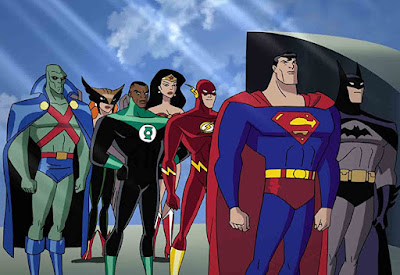
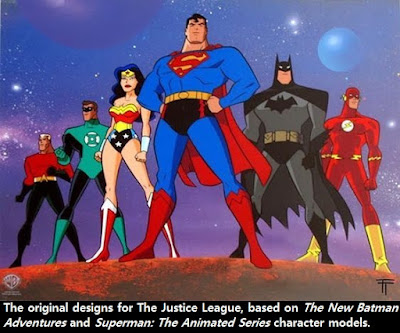
In the late 1990's, thanks to the success of the Batman and Superman cartoons, Warner Bros. Animation decided to proceed with plans for a Justice League cartoon. There were many ideas floated around the offices of Warner Animation about how to bring the show to life. First and foremost, Bruce Timm and his team would be the showrunners, for obvious reasons.

The show was originally going to feature the classic Silver and Bronze Age versions of The Justice League. Barry Allen was set to be The Flash, Hal Jordan was going to serve as the show's Green Lantern. Hawkgirl was not going to appear and John Stewart was only supposed to make a cameo appearance. Aquaman was also meant to be a main character. The producers abandoned that approach as they thought it would feel like an extension of the old Super Friends cartoon. More diversity was desired and they wanted the show to feel modern. So, Hal and Barry were deleted and they brought in John Stewart (who was more brash and aggressive than Hal) and Wally West (who was considered by Bruce Timm to be younger and cooler than Barry). Hawkgirl was added for more female representation as well. Martian Manhunter, the alien known as J'onn J'onzz, was originally set to make only a few cameo appearances in a couple episodes. The producers felt, since he was a founding member of the team, that J'onn  should be part of the main cast.

Justice League debuted to much fanfare on Nov. 17th, 2001 on Cartoon Network. The show was clearly an extension of the DC Animated Universe and all the characters were faithful to their comic book counterparts. Kevin Conroy returned as the voice of Batman but Tim Daly was replaced by George Newburn as the voice of Superman. 

The great thing about this show is, because of the ensemble cast and their differing traits and characterizations, a diverse set of plots and adventures could be had. Wild science fiction stories could be told along with the more grounded crime fiction shows. Because it's a team show the character interactions are what make it special. We get to see how each of the main characters approach their roles as superheroes and how they sometimes clash with their teammates. 

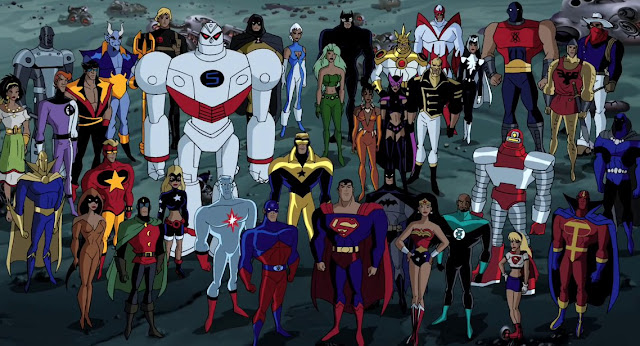
In 2004, the show was rebranded as Justice League Unlimited (abbreviated to JLU). Bruce Timm has famously said that the final episode of season 2 was supposed to be the finale but, because of high ratings, Cartoon Network ordered more episodes. Rather than continue on with the same show, Timm and his producers decided to make a new show that was based on those first two seasons. Rather than simply show the Justice League in more cartoons, the new show would feature an expanded cast from all corners of the DC Universe.

The new cast included the original show's stars but now featured Green Arrow, Black Canary, The Question, The Huntress, Supergirl, Booster Gold, and Captain Atom, among others. Justice League Unlimited was a broader show than its predecessor with many multi-part story arcs. It continued to explore the main characters motivations but also seemed more operatic in scope. The fun sense of adventure and banter between the characters remained but I think the new show told better stories. A fun thing for any DC Comics reader to do is to watch the show and see how many tertiary characters you can spot. I always remember seeing some of my favorites (like Swamp Thing) appear briefly in the Watchtower (the Justice League satellite headquarters).

In many ways, this is my favorite superhero cartoon based on DC characters, even if I revisit it less than BTAS or Superman. The expanded cast and the expertly crafted writing and dialogue shows that Bruce Timm, Paul Dini and the other producers really understand these characters and the world they inhabit. Justice League was a great team-up show with a lot of heart. JLU was all that and more, telling deeper, more layered and dramatic stories while still managing to be fun. I know this is a beloved show and I highly recommend it as well. It's reputation is well deserved.

Tuesday, October 26, 2021

The Flash (1990) - Review and Analysis

The Flash debuted in 1990 on CBS as TV's answer to the 1989 Batman film. It started life as a treatment for a superhero show in 1988. The project, pitched by executive producers Danny Bilson and Paul De Meo, was called Unlimited Powers. The premise followed a team of four superheroes (The Flash, Green Arrow, Dr. Occult, and a man made of rock called Block) that would cease using their powers by government order after the U.S. and Russia created a "Limited Powers Act" to help promote world peace. The Flash would be one of those heroes and would refuse to give up his powers. CBS loved the idea of a superhero show but told the producers to use only one hero because of cost concerns. 

Bilson and De Meo chose The Flash. There was a problem though. DC wanted to promote Wally West as The Flash because, by 1990, Barry Allen, the 2nd Flash, had died in the Crisis On Infinite Earth's saga that closed out the Bronze Age. Wally was formerly Kid Flash, Barry's sidekick, but the producers hated Wally as The Flash. So, compromise was reached. This new show would use Barry Allen as The Flash and combine the character with aspects of Wally. Barry Allen, the police scientist, would have Wally's red hair and need to eat a lot of food to maintain his metabolism. They also wanted the show to be dark, urban and dramatic. They used the Batman movie as a template for how the show would look. Art-deco buildings and vintage cars were merged with current technology to give the series a timeless quality.    
The search was on for a great cast. Bilson and De Meo tested more than fifty actors for the lead role. Eventually, John Wesley Shipp, an Emmy award-winning soap opera star, was cast. He didn't know anything about comic books or The Flash and had to do a lot of research. At first, when he was told about the project, he declined, as he didn't want to be seen in tights. After reading the script, he was impressed enough to audition. Shipp has a lot of charm as Barry Allen and plays the role with such confidence and sincerity that you constantly root for him. This is how a superhero should look and act on screen. 
Amanda Pays was cast as Tina McGee, a scientist and love interest for Barry who was then Wally's girlfriend in the comics. Alex D
ésert played Julio Mendez, a character created for the show, that served as Barry's lab partner. While both Amanda Pays and Alex Désert are fun to watch, they lack the charm of a well-rounded cast when compared to later superhero shows like Lois and Clark but, if given enough time to develop I'm sure they would have been stellar.
One of the special and most remembered things about this show is the Trickster cameos, played famously by Mark Hamill, before he became even more famous for his role as The Joker on Batman: The Animated Series. Here, Mark Hamill has fun in his role as the psychotic villain and, by his own admission, he even lobbied for the part. The Trickster episodes are some of the most fun episodes of the series entire run. 
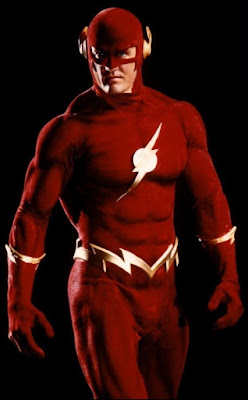
Famed comics artist and Rocketeer creator, Dave Stevens, drew the concept art for the Flash costume. 
The costume was a driving force in getting the show off the ground because, without a credible costume, this show wouldn't be taken seriously. Having seen what Warner Bros. had done with both Superman: The Movie in the 1978 and taking cues from the then-new Batman film, Bilson and De Meo knew that the Flash suit could make or break the series. They knew they didn't want spandex as it wouldn't accentuate the human form or offer a heroic look. They also wanted to deliver a movie quality superhero costume on a TV budget. After wrestling with CBS, who wanted The Flash to wear a gray sweatsuit without any superhero motifs and no mask, Bilson and De Meo compromised. They would get the red Flash costume that they wanted, but The Flash couldn't wear any yellow boots. 
So, after enlisting award winning costumer Robert Short, famous for his work on Star Trek: The Motion Picture (1979), a prototype costume was created out of latex. They used various techniques such as flocking, sculpting, and painting to create a suit with a unique muscular texture. Eight suits were made at a total cost of nearly $1 million USD. The suit itself was very hot and claustrophobic to wear. John Wesley Shipp lost some weight in the suit at first and considered seeing a shrink for his claustrophobia until accommodations were made. Cooling vents were installed in the suit to keep the actor cool and his time in the suit was more limited. As difficult and expensive as it was to bring the Flash suit to screen, it looks amazing for 1990 and, in my opinion, remains one of the best superhero costumes ever produced for any production.

After six weeks of filming (and nearly $6 million), the 90-minute TV pilot debuted on September 20th, 1990 and was a resounding success. The show ran for a season but after twenty-two  episodes, the series was not renewed for a second season. That's most likely because of it being an effects heavy show, expensive to produce, and it faced stiff competition in the form of The Simpsons and The Cosby Show. It's a real shame that this show wasn't renewed because, by all accounts, the second season was supposed to be even more effects heavy with a bigger budget. The season two pilot was supposed to be a two-part feature that had multiple classic rogues of The Flash in a plot to take down the Scarlet Speedster. 

Once the dust settled, multiple episodes of this series were edited together for three direct-to-video movies. The Flash (1990), The Flash II: Revenge of The Trickster (1991), and The Flash III: Deadly Nightshade (1992). Later still, John Wesley Shipp (and a few of his fellow cast members) returned to the new Flash show in 2014. Here, Shipp played Barry Allen's dad, Jay Garrick (the Golden Age Flash), and even cameoed as his own character, The Flash, in a crossover episode with Arrow and Supergirl
This show is fondly remembered by many older superhero fans and Flash fans. For fans of the newer Flash series, this might be a welcomed surprise. It's a fun watch with a lot of heart. Highly recommended.