Monday, May 10, 2021

The Neo-Noir of Mister X and the Radiant City Trilogy


Published by little-known (and now defunct) Canadian publisher, Vortex Comics, Mr. X was a wild idea. Bringing together the neo-noir/science fiction of films like, Blade Runner, with the pulp magazine sensibilities of the 1930's and 40's, it manages to weave together an intriguing mystery.

Written by Dean Motter with art by such luminaries as The Hernandez Brothers and Seth, Mister X tells the story of a mysterious character, a bald architect wearing dark glasses and a trench coat, haunting the streets and secret passageways of Radiant City, trying to piece together why Radiant City's architecture is driving its citizens mad. Mister X claims it is his job to fix things. He is a drug-fueled, paranoid, insomniac architect, obsessed with finding a cure for its people while going up against the city's corrupt officials.

But why him? Who is Mister X? The series doesn't really reveal his true identity until the end as the majority of the story is spent figuring out his motivations and tries to deliver clues to the mystery.


L
ike independent projects such as The Rocketeer, Nexus, Love and Rockets, and other classics of the 1980's, Mister X  is well remembered by fans of that era. When Mister X hit the comic book stands in 1984, it was truly a unique and inspiring vision. The story, artwork and interesting coloring choice was part film noir and part German expressionism, in the vein of the classic film, Metropolis. This book is just as good as the biggies of the 1980's: Dark Knight Returns or Watchmen, albeit not nearly as important. Mister X captivated comics fans and creators alike, but sadly, may not be known to present day comics fans. This is Dean Motter's best work. It can be held up as one of the comic medium's best stories ever told, in my opinion, though fans new to the medium or those acustomed only to modern comics may not appreciate it as much. Still, it's quite disturbing, violent, visceral and enthralling all at once. Amazing!


If you wanna check this out, it has been collected by Dark Horse Comics in an archived edition. Definitely a must read for any fan of pulp/sci-fi comics and worth collecting for fans of offbeat 80's comics. 
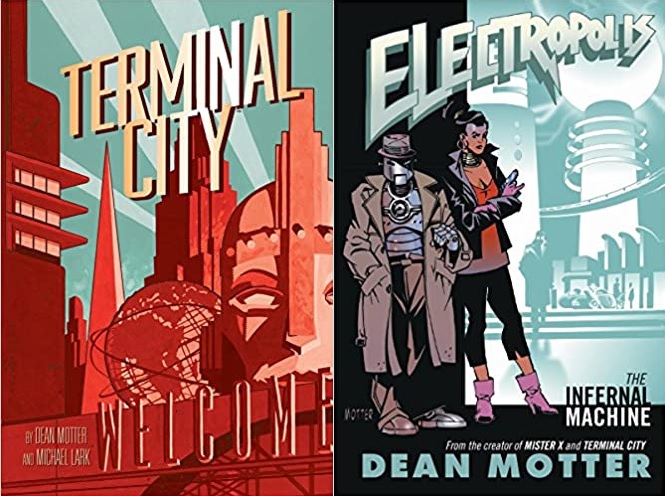


Sometime after the Mr. X series was published, Dean Motter published 2 unofficial sequels. Terminal City (released sporadically in the middle 1990's) and Electropolis (which was released in the 2000's). While this is considered by Motter fans to be a trilogy, the stories aren't really connected. The latter books are at least peripherally related to Mr. X and Radiant City as they take place in the same universe, but don't really further the story of Mr. X. 

Terminal City is a bright spot in the overly grim, overly drawn, event-driven comics of the 1990’s. This work is such a breath of fresh air, an alternative to superhero comics of the time. Terminal City is the purest vision of Dean Motter’s retro-futurism. This series melds Bruce Timm’s Gotham City and Asimov style sci-fi into a loose story about aging daredevils and a mysterious briefcase. This is a world where old art deco buildings clash with futuristic ones, where robots and flying cars mesh with old time gangsters and where gorgeous femme fatales try their damnedest to take advantage of unsuspecting men. The plot is kind of zany, involving a crooked mayor, a crooked industrialist, land schemes, missing and legendary crown jewels, a naive newcomer to town, and an old boxer. The hero is Cosmo Quinn, former "Human Fly" daredevil turned window washer, but the Grand Hotel-like plot jumps between multiple stories and characters. Readers will catch references and homages to old noir films, Abbott and Costello, and even Tintin. The art by Michael Lark is straightforward and easy to look at, while the colors and vivid and expressive. This is recommended if you like noir-ish shadows melding  with technology in a way that the cyber-punk genre may have attempted but never fully succeeded in delivering the way this does.

The later story, Electropolis, features Menlo Park, a reprogrammed janitor robot working as a private detective on the neon streets of Electra City, a sister-town of Radiant City, that's been designed to generate and conduct massive amounts of electricity. Sixteen years after the apparent suicide of his human partner atop the world's tallest tower, a blond femme fatale gives Menlo some new information about the cause of death. As Menlo and his assistant, Anesta, reopen the case, their journey takes them from Electra's high society to its dark underbelly. Of these 3 stories, it is the weakest, if only by default because the other 2 are so good. Of the 3 however, this feels the most straight forward and is more like an old film-noir plot than anything else. Motter handles the art chores here and  delivers some great panels. Definitely recommended.

Sunday, April 11, 2021

Frank Robbins Deserves Credit For Helping Create "The Dark Knight"

Frank Robbins is the only writer in Batman's history that has the distinction of being THE transitional Batman writer. Having taken over from Gardner Fox, Robbins worked on:
Batman #204–207, 209–212, 214–217, 219–222, 226, 230–231, 236, 246, 249–250, 252, 254 (as writer from 1968–1974) and Detective Comics #378–383, 386, 388–436 (as writer); #416, 420–421, 426, 429, 435 (as writer/artist from 1968–1973).

Batman fans often hear about how Denny O'neil and Neal Adams changed the character from the campy Caped Crusader into The Dark Knight. This is true, but it's a partial truth. Frank Robbins was writing and drawing Batman before Denny and Neal and it was his work that first brought maturity to Batman. He also wrote both flavors of Batman, campy and dark. As much as I love Denny O'neil, who I consider to be in the top 5 comic book writers of all-time, he and Neal (perhaps DC's greatest artist of all-time) cannot take, nor do they deserve, all the credit, despite what most popular blogs like IGN or CBR might have you believe.

Robbins' Batman stories started out in the same vein as Gardner Fox. They were simple, juvenile detective and mystery stories. About halfway through his run, he created Man-Bat with Neal Adams, and started the shift that marked the beginning of the transition from The Caped Crusader into The Dark Knight. In fact, Batman's appearance first changed, under the pencil of Neal Adams, in one of Robbins' stories.
He also wrote Batman #217 where Dick Grayson moves off to college and this forces Bruce to return to his roots, becoming, once again, the lone obsessed vigilante. Robbins also penned The Batman Nobody Knows, a short story from Batman #250. With art from Dick Giordano, this serves to illustrate that the Batman is a legend who is frightening to criminals. One of Batman's greatest stories, it was loosely adapted for both The New Batman Adventures episode, Legends of the Dark Knight, and as one of the shorts in the Batman Gotham Knight animated anthology film from 2008.
As much as Denny O'neil deserves credit for The Secret of the Waiting Graves (Detective Comics #395), which cemented the change in both focus and tone, without Frank Robbins to lay the stepping stones Julius Schwartz may never have hired Denny to write it. The record has to be set straight... Denny and Neal had a little help in creating The Dark Knight version of Batman. It was a recipe with many cooks, including other artists such as Irv Novick, and Jim Aparo. Robbins gets ignored by history just as, sometimes, Denny and Neal get casually ignored for bringing Batman back to his darker roots in favor of Frank Miller's 1980's work. But Frank Robbins is important to Batman too.

Sunday, April 4, 2021

Superman Smashes The Klan! - A Comic Review and Analysis of Superman Vs Hate Groups


Superman Smashes the Klan! And he's been doing so for about 75 years. The Man of Steel first encountered the KKK in his very own radio show in the 1940's. It seems that every generation or so, DC Comics publishes a story dedicated to Superman fighting either the Ku Klux Klan directly or some group that was indirectly inspired by what the Klan represents. In that way, Superman has never completely lost that sense of truth and justice that Jerry Siegel and Joe Shuster gave to their character. He has always remained something of a social crusader.


It began in 1946. The Anti Defamation League had infiltrated the KKK. The ADL contacted the Superman radio show and suggested that they feature a story where the titular hero faces the Klan. Over 16 episodes, from June to July of '46, "Clan of the Fiery Cross" aired and Superman took his war to the fascist menace.   


And as for the comic? Well, this story is a new take on the saga that is the "Clan of the Fiery Cross." In the 3-part miniseries, written by Gene Luen Yang with art by Gurihiru, Superman is in his younger days. He helps an immigrant family, battles racists, and finds himself grappling with life as an alien outsider. Like the radio show from which it drew inspiration, the story takes place in 1946.

The story seems to take a lot of inspiration, not only from the radio show (even The Atom Man appears), it is visually inspired, at least in part, by the Fleischer cartoons. It's a brisk story with appropriately cartoony art, that seems to offset and balance the seriousness of the subject matter. This is a great ode to Superman's Golden Age. It's also very topical, considering the times we live in. What I like most about this story is that it squarely defines the KKK and their sympathizers as the enemy. Superman has some of that hutzpah, here, that he had in his earliest days. The Champion of the Oppressed has returned and... if there was ever a time for him... the time is now! Thanks, Superman, for fighting fascism and taking it to these bad guys! Recommended for all ages. This is a masterpiece and should be read again and again.

Thursday, March 25, 2021

In Defense of Joel Schumacher's Batman!


It's important to remember that Joel Schumacher, by his own admission, was a Batman fan. Had he had his way, he might have adapted the seminal comic book story, Batman: Year One. Alas, that's not what was made. For what he delivered in 1995, Batman Forever is not a bad film, and looks incredible. It's the most comic book looking version of Gotham City with its fascistic architecture, neon lights and colorful alleyways. There's a darkness to the city that looks more like something out of a mid-1990's music video on MTV than the dirty, mysterious, expressionistic metropolis that Burton gave us in 1989. So, yes! Gotham looks like the Gotham that was appearing in the comics of the mid to late 90's: colorful, overblown, and big. The other sets all feel very much like Batman to me, and the "Forever batmobile" was my favorite as a kid (since I was teen however, I lean hard to the '89 Burton-mobile).

The costumes were quite good for their time as well. The batsuit known as the "Panther suit" was a sleek and sexy update from the first Keaton suit. But then rubber nipples were added. They make no sense, are garish, homo-erotic and unnecessary. They add nothing to the film at all... except unintentional humor. "Tee-hee, Hee-hee! Look at those nips, oh my god!" My point is, the Panther suit, sans the nipples, was quite good. Robin's costume is the closest to the Neal Adams Tim Drake design that we are likely to ever see in a major Hollywood production... again, it looks great, sans the nipples, though it coukd have been a little less metallic and shiny. The "Sonar" suit was reminiscent of many of Batman's alternate costumes over the years in the comics. The villain costumes are also excellent. As far as aesthetically, they are striking, pretty accurate to the source material and fit the overall look of the film... even if the Two-Face makeup could have been redesigned to look more realistic.

The acting is quite over the top, at least in the cases of the villains and, if the script had been less ham-fisted, more thoughtful in its approach and played with more drama, the overall film would have been much better. The problem comes in the fact that the movie is incapable of juggling its tones. It wants to be serious and dramatic but is also far too campy and loud. Where I think the film shines is in its drama. I think Kilmer was an excellent Batman and a thoughtful, charming Bruce Wayne. His performance shows that he understands Batman. Chris O'Donnell was as good as the script called for. I believed him as Robin and bought his trauma. Overall, I enjoy the film and think if Jim Carrey and T.L. Jones (both very capable actors) had the opportunity for more serious performances, had the drama outpaced the humor, this film would be highly regarded today. This film had potential.

Batman and Robin is an entirely different animal. Rather than dissect it completely, all I can offer is what I like about it and, perhaps offer some suggestions to what might have improved it. I think, like its predecessor, the film is great looking. The cinematography is tight and it feels like a dark comic book movie, in places. Most of the film is a fever dream, an acid trip. This comes down to a bad script. Mostly.

George Clooney's sincerity as Bruce Wayne proves that he could have been a better Batman than he was. I'm not sure that his acting range would have allowed for a "Dark Knight" type of grim avenger, but with a better script, and a better suit, he could have done better. Chris O'Donnell's performance feels phoned in, but it's consistent with his portrayal of Dick Grayson in the previous movie. I always liked the Nightwing inspired costume too. Barbara, as played by Alicia Silverstone is wrong. But, I'm a fan of Babs Gordon in the comics. Sometimes, I feel like if she dyed her hair red and had given a less wooden performance, she could have been great... that is, IF she had been Jim Gordon's daughter. Then again, I'm not sure if she is a good enough actress to tackle the brainy, determined Commissioner's daughter from the comics. The villains were great looking, but the acting was bad. Uma Thurman looked like Ivy but her performance was dreadful... she's a better actress than what the script called for. Arnold Schwarzenegger as Freeze, again, he looked the part and his suit was awesome. The performance however, and the numerous sight gags and ice puns, were not what a Batman film needed. Bane, well, it wasn't the character from Knightall. He wasn't cunning or strategic, just more of a hulking brute.

I think Schumacher is a great director who was gifted with talented actors. The studio, the scripts by Akiva Goldsman, and the insistence to tone down these films into pop-oriented summer entertainment is what hurt these films. I really enjoy Batman Forever and I think it deserves a better legacy. Batman and Robin has some amazing looking scenes and shots. Aesthetically, it's not really that bad. Even the plot is decent. But too many one-liners, too much camp and the over-the-top nature of the film make this one of the worst films of all time. Had the stars aligned, had Schumacher been given more control and a better script, Batman and Robin would not be a bad movie. 

Sunday, March 7, 2021

Spawn: The Poster Child of The Dark Age of Comics

Spawn, created by Todd McFarlane, was THE comic book character that ushered in the 1990's Dark Age of Comics. He has his antecedents and the precedent for characters like him were set by the culture of the late 80's. Not only was Spawn (and characters like him) brought about because of the sophistication and mature themes of comics like The Dark Knight Returns and Watchmen, but also popular rock music of the time and the youth-centered culture of MTV.

Debuting in May of 1992, Spawn #1 sold 1.7 million copies and, for a long time, was the biggest selling indie-comic of all time. The book tells the story of Al Simmons, a mercenary that works for the U.S. Security Group, a government agency commanded by Director Jason Wynn. When Wynn sets him up, he is killed and goes to Hell. Making a deal with the demon, Malebolgia, Simmons agrees to become a Hellspawn and lead Hell's army if he is allowed to see his wife, Wanda, one last time. Simmons returns to the living realm, badly burned and under supervision of Violator, a demon disguised as a clown. After his death and subsequent rebirth, Simmons is now Spawn, a powerful Hellspawn who is thrust into several adventures where he takes down street gangs and organized crime in the city of New York.

I was about 7 years old when Spawn debuted and completely missed out. I was most intrigued by the action figure line of the the mid to late 1990's. By that time, McFarlane Toys was a powerhouse in the toy industry and Spawn figures were everywhere. The character always intrigued me for his darkness and edginess. His storyline was always very intriguing, but I would not read the comics until I was much older.
I did catch the 3-season Spawn animated series at various times as a kid. It debuted in 1997 on HBO and seemed so adult, mature, and sophisticated at the time that I was instantly a fan. It was made for mature audiences but was not very sophisticated. The animation is very well done by 90's standards but the story can be very deliberately paced. I still enjoy it when I see it these days, though I recommend watching it in one 6 hour block. It unfolds very well if you watch it in one sitting and tells a compelling story. If you watch it over time, it is not as easy to digest.

Also in 1997, the Spawn movie was released in theaters. I watched it for the first time in the late 1990's and thought it was well done. It's a basic origin story with a decent plot. Even with it's bad CGI and mediocre special effects, by today's standards, it's an entertaining, dark actioner. There are some corny bits but, if you're a comic book fan, it can be enjoyable. It does routinely get thrown on the "Worst Comic Book Movies of All Time" list. I disagree. It's fairly well done for a 90's action film and is a decent adaptation of the early Spawn book. I think at the very least, if you're a Spawn fan, you should get something out of it.

There are some comic book readers, veterans of the hobby, who dismiss Spawn as a product of the 90's, an edgy, overblown summation of the comic book Dark Age. For many, he belongs in the 90's and is not very compelling. I disagree. For me, he's far more than that. Spawn is a timeless character who sells his soul so that he can reunite with his loved ones, a violent man at war with himself.
I would recommend watching the animated show at least. If you want to read the comics, start at the beginning with issue #1 and read until about issue 50, at least. If you still like it, keep going. The comic is quite well done, especially the early issues, some of which were written by Grant Morrison and Alan Moore. That said, as with any back issue comic book, it can be dated. But what do you think? Do you like Spawn? Is he a cool concept or, does he amount to nothing more than the ultimate edgy, dark antihero?


Wednesday, February 3, 2021

Galactic Guardians Presents: The Fear

I have been spending a lot of time lately watching various episodes of Batman: the Animated Series. The show is, of course, so good that it got me thinking about Batman's history in cartoons. Batman debuted in cartoons during the 1960's thanks to the now infamous company, Filmation, as part of the Batman/Superman HourThe Batman bits of that show eventually got repackaged as The Adventures of Batman. This of course led to the better known ABC broadcast, Super Friends, in 1973 that lasted until 1985. Batman had a starring role in the Super Friends series, which was animated by Hanna-Barbera. A short-lived cartoon ran concurrently with that called The New Adventures of Batman


The
final season of Super Friends got rebranded for ten episodes as The Super Powers Team: Galactic Guardians. Pre-BTAS, this is the most serious that superhero shows ever really got. Which brings us to The Fear!    

This screenshot from The Fear shows the first ever "dark" Batman in animation.

The Fear
is the first time ever, outside of comics, that Batman ever got dark. Of course, it wasn't as dark or sophisticated as anything that Bruce Timm and Co. would give us in the 90's but, for 1985, this was well done. They couldn't really do anything beyond the level of  cartoons for 8-year-olds because Standards and Practices in children's animation back then was far more conservative. The Fear raised the bar for superhero cartoons and is probably the best DC superhero cartoon made before the 1990's.

Here, Batman is terrified of Crime Alley, the place where his parents were murdered. The Dynamic Duo chases Scarecrow and his Strawmen (because, what else would you call Scarecrow's henchmen, LOL) towards Crime Alley but once Batman realizes where he is, he freezes. Scarecrow gets away and Batman and Robin spend the rest of the episode dealing with his trauma and the Scarecrow tries to exploit his fear. At a party at Wayne Manor, Diana Prince (Wonder Woman) shows up and notices Bruce is not his usual self. At the end, the rest of the Super Friends show up and help Batman work out his trauma so that he and the Boy Wonder can stop Scarecrow's scheme. 

This is 21 minutes of superhero storytelling that rivals some of the darker toons that came later. Granted, this is still a kid's cartoon, and, when watched today might seem simplistic, but it's still important. It's the first time in animation where Batman is more than one dimensional and his humanity is explored. The episode is a gem in a series of otherwise saccharine and campy cartoons. Alan Burnett, producer of BTAS and other shows in the more modern DC Animated Universe also wrote this episode. He was one of the main writers on the Super Friends show. 

Because of the Super Friends legacy, the history of Batman in animation is really pretty weak until BTAS. That said, The Super Powers Team: Galactic Guardians is a fairly watchable, and sometimes entertaining show. The Fear remains its best episode and is a neat little artifact for fans, new and old, to discover. Anyway, I just discovered it and for those who have never heard of this episode, I highly recommend it for all Bat-fans!

Wednesday, January 6, 2021

The Blacksad Series - Review and Analysis


Blacksad
 is a series of wonderful noir comics that combines some of my favorite elements: detective fiction, anthropmorphized characters and period pieces. The comic is the brain child of the Spanish writer/artist team, Juan de Díaz Canales and Juanjo Guarnido. These guys are former animators who, at one point, apparently worked for Disney. Their love of film noir and detective stories spawned one of the greatest comics in years. These were originally published in French but have been translated to Spanish and English.

John Blacksad is a cat in a world inhabited by animals. He works as a private detective in New York City during the 1950's. His stories feature themes that were true to life in the 50's as well: racism, atomic age paranoia, and post-war economics. The series is dressed with jazz music, gangsters, booze and dangerous women as well, to better illustrate the noirish flavor of this amazing  series.

Blacksad begins with the story Somewhere Within the Shadows. Debuting in 2000, this is where we meet John Blacksad, a hard drinking "Private Eye" in the vain of Phillip Marlowe or Sam Spade. He investigates the murder of a famous actress. The artwork is expressive, detailed, and perfectly captures the mood of a pulp detective story. It's probably my favorite story in this series.

Artic Nation, the second book in the series, came out in 2003. This one features some heavier subject matter. Blacksad searches for a missing girl named Kaylie. She has been kidnapped by a racist political organization called Arctic Nation. Their members are various animals, all with white fur, to draw allusions to the KKK and white supremacy. Another gang called the Black Claws generate themes of interracial conflict as well. Blacksad's struggle to find the missing girl is interspersed throughout these heavier themes.

The next in the series, Red Soul, was released in 2005. This features themes of America's two biggest fears during the era, nuclear annihilatioin and the communist "Red Scare." This story sees Blacksad mingling with all sorts of characters in the city's social scene to get to the bottom of a mystery. It's not as heady as the previous story but it's still very intriguing.


Dark Horse Comics would later publish these first three stories as a single volume in 2010, simply titled Blacksad, and translated into English


Book four,
A Silent Hell,
 also appeared in 2010. This story, set in New Orléans, features Blacksad and his pal Weekly (a reporter who's also a weasel) traveling there to meet Faust (a goat who's also a failed musician). The goat has a terminal illness, and is treated by voodoo high priestess. Faust commisions Blacksad to find an old friend of his. This story was a lot of fun and the artwork captures vintage New Orleans very well. 


The final tale (so far) is called
Amarillo
Amarillo is Spanish for "yellow." Released in 2014, this one concerns two beatnik types: a lion named Chad, and his hotheaded bison friend, Abraham. Blacksad is still in New Orleans on holiday but Weekly goes back to New York. This is one of those stories where the adventure finds the protagonist. Blacksad just kind of falls into the plot. Our hero is approached by a wealthy Texan (a steer) to drive a vintage yellow car  on a cross country road trip from New Orleans to Amarillo, TX to Denver, CO, and finally to Memphis TN, where we meet Blacksad's sister. The whole thing culminates in a murder that has to be solved. And what does 
Luanne, a Siamese cat with psychic powers and a knife-throwing boyfriend, have to do with this? It's another very good story that has all the trappings of a great pulp-inspired adventure, though it seems brighter than the other stories, in both tone and artwork.

All in all, the Blacksad stories are probably the greatest pulp detective stories in modern comicdom. The artwork is reminiscent of storyboards for a Disney film and the writing is as sophisticated as any pulp novel. Rumor has it, there are supposed to be more stories on the way but they have yet to be published. This series is truly unique and highly recommended for anyone who loves comics.


Saturday, December 26, 2020

The Wrath of The Spectre!

In the 1970's, DC Comics resurrected one of their darkest and most powerful characters, The Spectre. In the 1940's Jim Corrigan (as created by Jerry Siegel and artist Bernie Baily) emerged as one of DC's first detective/superhero characters. His stories were dark even for the Golden Agee, a time when comics were less censored and unafraid of telling edgy stories. In the 1970's he was brought back in this series, masterfully written by Michael Fleischer and drawn by Jim Aparo. These stories were groundbreaking in that they were considered very violent for the time. This series established The Spectre as one of the darkest and probably the most vengeful of all superheroes.

Beginning with the 12-page "The Wrath of ... the Spectre" in issue #431 of Adventure Comics, writer Michael Fleisher, and artist Jim Aparo produced 10 stories through issue #440 that became controversial for what was considered gruesome, albeit bloodless, violence. Joe Orlando plotted these stories with writer Michael Fleisher, and they emphasized the gruesome fates of criminals who ran afoul of the Spectre. The Comics Code had recently been liberalized, but this series pushed its restrictions to the limit, often by turning evildoers into inanimate objects and then thoroughly demolishing them. Jim Aparo's art showed criminals being transformed into everything from broken glass to melting candles, but Fleisher was quick to point out that many of his most bizarre plot devices were lifted from stories published decades earlier in various Golden Age comics.

This series made me an instant fan of The Spectre and I became someone who sought out the work of Michael Fleischer (his 1970's Jonah Hex run needs to be read by all). And then, of course, there's the art by Jim Aparo. Anything with Jim Aparo's immortal name attached to it is instantly going to be good. Anyway, this series was printed in trade paperback in 2005 and went quickly out of print. DC just released an omnibus of this run (with some supplemental material), so it's available again. If you're a fan of darker heroes, like horror comics or ghost characters, you should definitely check out this run.